




Contrary to popular belief, Japan is nowhere close to the most expensive place to live (ranked around 46th in the world), which is great news for international students. While Japan can be quite affordable for students, some expenses still add up. Major cities such as Tokyo, Osaka, Kyoto, and Nagoya can cost a pretty penny, especially for rent, but overall, living expenses can still fit within a reasonable budget.
Abundant cheap eateries, a convenient transportation system, and subsidized tuition fees can help alleviate that financial strain. Excluding your school tuition, whether it be for vocational and Japanese language school or university, let’s find out everything you need to know about living costs, including rent, food, and utilities, for foreigners studying in Japan.
How Does Cost of Living in Japan Compare to the United States
Before we start throwing around figures and prices for living costs in Japan, it helps to see how they compare relative to other countries like the U.S. Let’s get a big-picture view of how key Japanese expenditure indicators measure up against the United States and global averages. All figures below are average monthly expenses, excluding school fees and tuition.
| Japan | United States | |
|---|---|---|
| Total Expenditures | $659~ (¥149,000~) | $2000~$3,000 (¥318,000~¥477,000) |
| Rent | $376 – $565 (¥60,000 – ¥90,000) | $1,500 – $2,000 (¥239,000 – ¥318,000) |
| Food | $250 (¥40,000) | $250 – $400 (¥40,000 – ¥64,000) |
| Utilities | $113 (¥18,000) | $100 – $200 (¥15900 – ¥31800) |
| Medical Insurance | $18 (¥3,000) | $125 – $250 (¥20,000 – ¥40,000) |
This is based on the average prices that students pay for each expense category. Overall, living expenses in Japan are much cheaper than in the United States, but this can vary depending on location, lifestyle choices, and general price fluctuations. If we factor in transportation costs, the U.S. generally requires owning a car, whereas Japan has widely available and relatively affordable public transportation.
But in either case, if you’re living on campus, you might not need to travel every day, so transportation costs could be relatively low. However, living on campus in the United States can be more expensive in other ways, since food and utilities usually cost more. Additionally, other costs for international students may vary, including visa fees, which recently increased in Japan.
So, let’s explore the actual expenses to contribute to Japan’s cost of living.
The Big Picture: Average Cost of Living in Japan
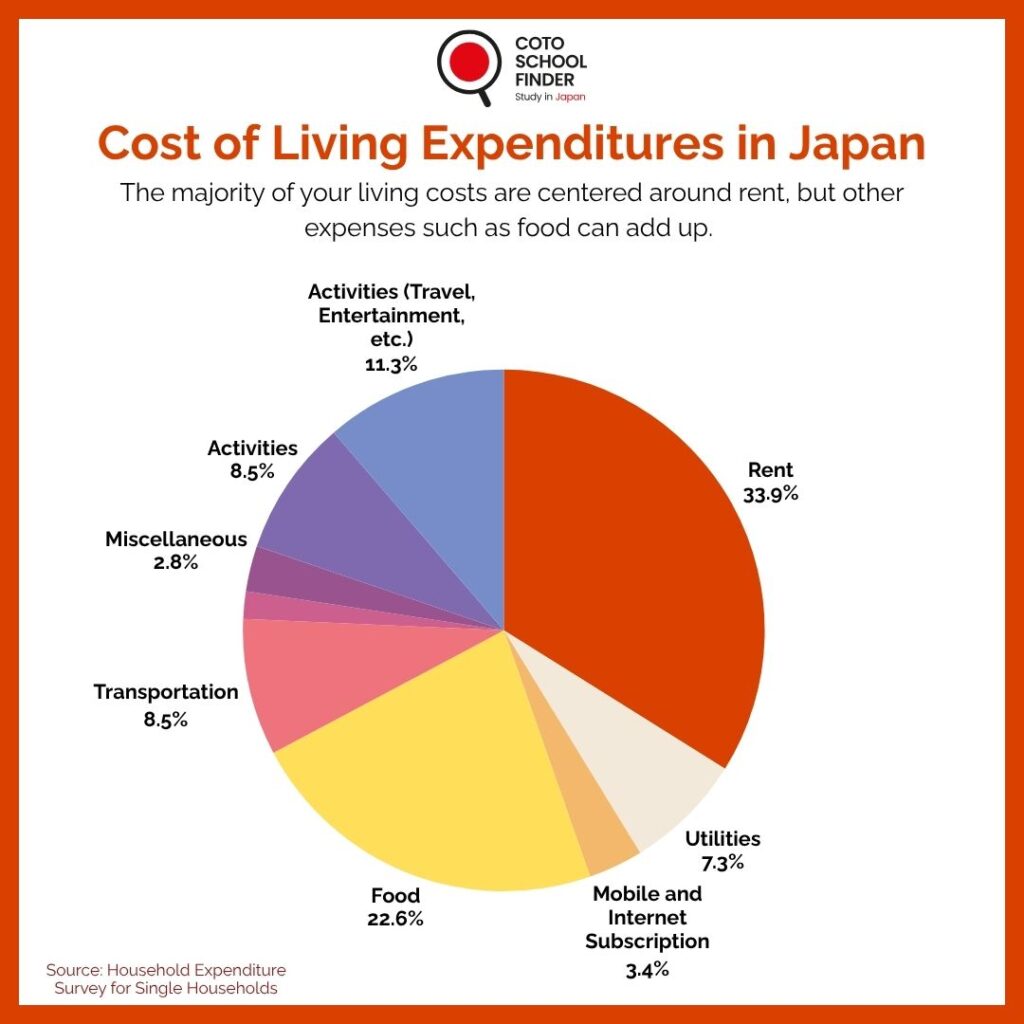
For students studying in Japan, below is a monthly breakdown of the average costs of living in Japan:
| Category | Amount |
|---|---|
| Rent | ¥60,000 |
| Utilities | ¥13,000 |
| Mobile and Internet Subscription | ¥6,000 |
| Food | ¥40,000 |
| Transportation | ¥15,000 |
| Insurance and Medical | ¥3,000 |
| Miscellaneous | ¥15,000 |
| Activities (Travel, Entertainment, etc.) | ¥20,000 |
| Total | ¥172,000 |
Figures based on data from 2025 Expenditure Survey for Single Households and realestatejapan
These figures are based on average national data for single households, while rent is based on average results for single apartments. Since averages can be influenced by outliers, the total expenses shown here could be much higher than the actual costs you could experience in other areas. So, if you live on the outskirts of Tokyo or in other prefectures (like Saitama) with a roommate, rent could be significantly lower.
Think of it this way: in bigger cities like Tokyo, the average cost for an international student is roughly ¥150,000 to ¥180,000 a month, but in other smaller cities, this figure could be much smaller. Additionally, if you budget and live more frugally, you can lower your expenses substantially, even down to ¥80,000 – ¥90,000.
So, as a student, you probably won’t spend as much as the average family, even single households. So, what does the average cost of living in Japan as a student look like? And how does it vary by region?
Want to study and live in Japan on a 6+ month program? Find the perfect language school and make your student visa application easy with Coto School Finder’s free service! Contact us for a free consultation and full support!
Cost of Living in Japan as A Student by Region
Unsurprisingly, Tokyo has the highest average monthly expenses for international students at around 130,000, where the national average living cost (excluding tuition fees) sits at around ¥105,000.
| Area | Monthly Expenses |
|---|---|
| Kyushu | ¥82,000 |
| Shikoku | ¥80,000 |
| Chugoku | ¥84,000 |
| Tohoku | ¥82,000 |
| Chubu | ¥89,000 |
| Hokkaido | ¥94,000 |
| Kinki | ¥101,000 |
| Kanto | ¥123,000 |
| Tokyo | ¥130,000 |
| National Average | ¥105,000 |
Data taken from the 2023 Lifestyle Survey of Privately Financed International Students
Average expenditure for students is much lower in regions outside of Tokyo and Kanto, which might be worth considering when deciding on the right school for you. So now, let’s take a closer look at all the different expenses that you will probably need to pay while studying in Japan.
Rent and Accommodation Expenses When Living In Japan
The average monthly rent for students in Tokyo can range anywhere from ¥70,000 to ¥100,000, and nationwide, around ¥50,000 to ¥70,000. However, this may not reflect the true costs in specific neighborhoods. Rent can be much lower in more residential areas or much higher in city centers.
Accomodation costs heavily depend on your preferences, budget, and location (a real estate agent’s favorite word). Living alone in a privately rented apartment will usually increase the rent. Typically, to cut costs, students opt to have one (or several) roommates.
Rent generally makes up the largest bulk of your living expenses in Japan. You can choose between several options. Living with a host family, in dormitories, or in guesthouses may save you some money, as utilities (water, electricity, and gas) are usually included in the rent.
| Region | Average Rent for Single Room Apartment (1R to 1LDK) |
|---|---|
| Tokyo | ¥91,000 |
| Chiba | ¥61,000 |
| Kanagawa | ¥68,000 |
| Saitama | ¥63,000 |
| Kyoto | ¥57,000 |
| Osaka | ¥61,000 |
| Aichi | ¥56,000 |
| Fukuoka | ¥48,000 |
Data taken from realestatejapan
Utilities Fees When Living In Japan
The average cost of utilities for one person varies based on your individual usage and often fluctuates with hotter or cooler seasons. So, on average, total utilities cost about ¥13,000 to ¥20,000 per month. The water bill is basically paid once every two months in a lump sum, while electricity and gas bills are delivered to your address every month.
In summer and winter, the air conditioner is often turned on, so the electricity bill will be higher. So, don’t be too surprised if your electricity bill alone is well over ¥10,000 from January to early March, when most regions in Japan are at their coldest, as reported by the Bureau, Ministry of Internal Affairs and Communications.
| Utilities | Average Price |
|---|---|
| Electricity | ¥7,000 |
| Gas | ¥3,000 |
| Water | ¥2,000 |
| Other Utility Cost | ¥800 |
| Total | ~¥13,000 |
Data taken from the 2025 Household Expenditure Survey provided by the Japanese government.
Mobile and Internet Subscription
If you live in Japan long enough, getting a new phone number is more convenient than sticking to one you currently have. You’ll need a phone number for everything essential: opening a bank account, applying for a job, moving to an apartment, or registering a credit card.
Be careful with the voice communications part of the plan. Some plans include no communications, so every time you call, it’s extra on your monthly invoice. Some plans have one hour total per month free, regardless of the length of each individual call.
If you’re not careful in choosing your mobile plan, you may pay up to ¥4,500 a month. Affordable phone plans in Japan that we recommend are:
- LINEMO (formerly known as Line Mobile)
- Sakura Mobile
- Rakuten Mobile
Internet services in Japan can also be costly. They start from ¥3,355 a month and can go up to ¥6,000, depending on the service provider.
Food Expenses When Living In Japan
Next to rent, food expenses will take up the second-highest portion of your living costs. For a single foreign student, groceries can be around ¥5,000 a week if you budget, but in general, food costs will likely be around ¥10,000 a week. International students usually spend more on food because of differences in food availability in Japan. Costs will drop if you cook for yourself every day.
While Japanese supermarkets are fairly cheap in Tokyo, fresh fruits and vegetables tend to be more on the expensive side.
Although there are a lot of budget restaurant chains and fast foods in Japan, eating out every day can easily bump up your food expenses. Convenience stores offer good options for well-balanced meals (onigiri, salad, sandwiches) for ¥200-500. If you eat out for brunch in Tokyo or an izakaya once a week, for example, you will roughly spend ¥25,000-30,000 for food.
Transportation
Thankfully, as a student, even if you live a few stations away from your school or university, you will get a discounted commuter pass (定期券, teikiken). Since the commuter pass is also a Suica/Pasmo card, you can charge the card with extra money. When you travel outside your specified route, the cheapest route will be calculated when you exit, so you will be able to use the benefits of the commuter pass card even when traveling to a different station.
The average 1-month cost for students is roughly ¥5,000, including going out, the commuter pass, and part-time transportation expenses.
Tax, Pension, and Health Insurance
If you have a part-time job in Japan, your income tax is taken right out of your monthly stipend. Even if you are a student, if your income is above a certain amount, you must pay taxes in the same way as Japanese nationals. If you earn less than ¥930,000 a year, you are not required to pay income and resident tax.
Health insurance, which is compulsory for all long-term residents of Japan, is around ¥1,600 a month, but the premium is calculated according to your previous year’s income, including your part-time job. Unless you declare your income, it won’t be calculated accurately.
Hobbies and Entertainment
Going to the theatre, bowling alley, or batting center involves money. We’d say to do whatever floats your boat, but if you’re looking to stay under budget, keep in mind how easy it is to fall down the rabbit hole of spending, spending, and spending.
| Activity | Average Price |
|---|---|
| Movie tickets | ¥2,000 |
| Bowling | ¥600 – ¥1,000 |
| Karaoke (For 1~2 hrs during weekend) | ¥2,500 |
| Museum tickets | ¥600 – ¥1,000 |
For social activities like karaoke, the movie theatre, or the museum, the total amount depends a lot on your lifestyle and how active you are. If you go out a lot to do different things like going bowling, eating out, doing karaoke, or going to bars, you might be looking to spend around ¥15,000 to ¥30,000 per month on entertainment alone. If you’re looking to save up while still having fun, there are plenty of free and fun things to do in Japan. Public museums usually offer student discounts, which means you can buy exhibition tickets at a discounted price, or even for free. Go to parks, see the winter illumination, or take a stroll down the riverbank during Sakura season.
What to Consider When Planning Your Budget to Live in Japan
1. The area to live in Japan
In general, rent is cheapest in the outskirts of Japan’s three major cities: Kyoto, Osaka, and Tokyo, but even if you choose to live here, different neighborhoods can drastically reduce the price of your accommodation expenses. It’s your choice to splurge more to be near major stations like Shinjuku Station or Shibuya Station, or take a more affordable route and find an apartment in an area that is a little bit further.
The eastern and northern wards are the most budget-friendly wards in Tokyo, like Itabashi, Adachi, Arakawa, and Nerima. Which do you prioritize more: budget, space, or commute time?
A good general tip is to look at train lines and find areas easy to commute to. If your Japanese language school is located in Shibuya, where the average rent for 1R (one-room) apartments is ¥102,000, you would probably want to find an apartment (or a sharehouse) in Ota and Setagaya, where an apartment of the same size is on average ¥73,000. So, you don’t need to sacrifice too much commuting time for the trade-off of lower rent.
Apartment rent data taken from Suumo Average Rent by Tokyo Wards.
2. Different Lifestyle in Japan
When you move to a new country, it’s best to adhere to that country’s standards and lifestyle. Many people might feel that living in Japan is expensive because they are still consuming items considered cheap in their homeland, have unrealistic expectations, or haven’t adjusted their lifestyle. To really save money or avoid spending more than you need to, you should find out which types of food are cheaper (western food might be more costly), plan cost-effective commuting routes with the available public transportation, and use utilities efficiently.
Also, it’s worth asking: are you going to live alone, which would mean higher rent and utility costs, or share an apartment with a roommate to split the cost? Recently, flat-sharing has been popular among international students.
Many universities and agents provide accommodations and dorms, but these places are typically limited, too. For these lower-budget options, students often consider Oak House and Tokyo Share House.
3. Hidden Expenses when living in Japan
If you think you’ve had all the budget planned before you arrive in Japan, think again. You might get some whiplash when you find out some hidden (and miscellaneous) expenses that can throw your budget off track.
Medical insurance
All foreign students in Japan must join the National Health Insurance (NHI) scheme, which is usually calculated based on your income. According to the Official Shinjuku City website, people making an annual income of less than 1.8 million JPY, or around $11000. So, as a student, your premium will be discounted since you will likely earn little to no income.
This means total health insurance costs could be about ¥1,000 – ¥3,000 (around $10 to $20) per month.
Book and learning materials
Textbooks and study materials can cost up to ¥10,000 per semester. If you’re a university student, you may be required to purchase textbooks, which, admittedly, can be ridiculously expensive.
Apartment Initial Fees
Probably the highest upfront costs you’ll pay in Japan are the apartment initial fees. A good rule of thumb is to set aside four to five times the monthly rent for the initial move-in fees. For example, if your rent is ¥100,000, then the initial costs will be around ¥400,000 to ¥600,000.
- Security Deposit 敷金 (shikikin): Typically 1 month’s rent.
- Key money 礼金 (reikin): Upfront fee you pay to the landlord to sign the contract. Typically between 1-2 months’ rent.
- Key Exchange Fee: Typically, the key locks are changed when you first move into an apartment, so this fee is around ¥10,000 to ¥25,000.
- Cleaning Fee 清掃費 (seisou hi): You usually have to pay cleaning fees as part of the upfront costs, but some apartment companies will have you pay when leaving instead. Usually, the total fee is around ¥10,000 to ¥30,000.
- Guarantor fees 保証人費用 (hoshonin hiyo). A fee you pay to a guarantor company to act as your guarantor. Typically, around 50%-100% of a month’s rent.
- Rental agency fees 仲介料 (chuukairyou). Payable by the renter to the real estate company. Generally equal to one month’s rent + 10% consumption tax.
- Contract renewal fees 更新料 (koushinryou). Payable to the landlord two years after the start of a contract, at the time of contract renewal, and cannot be refunded. Typically, 1 month’s worth of rent.
- Fire Insurance 火災保険 (kasai hoken): This insurance covers damages from fire, smoke, and leaks; it typically costs around ¥15,000 – ¥20,000 for 2 years.
Note that not every company will make you pay every one of these fees. You can find some properties that drop certain initial fees, and if you use an agent, they can help you find properties with much lower initial fees. Some real estate companies pride themselves on offering properties with no key money, key exchange fees, or cleaning fees.
Internet Installation
If you’ve found your own place that doesn’t provide internet access, you will need to choose your internet service. Unfortunately, companies may require an installation fee, which ranges from ¥15,000 to ¥30,000 for apartments and condominiums.
Want to Live and Study in Japan? Get Your Application Started Today!
Coto is excited to announce that we’re offering a matching service to help students find a Japanese language school that provides student visas.
So if you want to come to Japan, let us help you! We provide free support — no agent fee. Our goal is to help make your dream of moving to Japan come true. Find a language school today and contact us!
FAQ
Is Japan expensive for students?
Not necessarily. With smart choices, students can live on ¥100,000–¥114,000/month in Tokyo.
How much is student rent in Tokyo?
Between ¥50,000–¥70,000/month. Shared housing or outer-city areas are cheaper.
Insurance (¥2,000), utilities (¥10,000), internet setup, move-in fees, and textbooks.
How can I save money?
Live with roommates, cook at home, use student discounts, and avoid daily eating out.
What’s a realistic monthly budget?
Around ¥150,000 in Tokyo. With a frugal lifestyle, as low as ¥80,000–¥90,000.