One of the most recognizable aspects of Japan is the iconic Japanese school uniforms. You’ve no doubt seen these outfits in all sorts of Japanese pop culture. Perhaps it is even worn by your favorite anime character. Even though many of us may have only seen these uniforms in fictional settings, they are as real as it gets, worn by Japanese students throughout their entire schooling until graduating from high school.
These uniforms did not evolve into what we know them as today, coincidentally. In fact, the history of Japanese school uniforms dates back further than people may think. In this article, we’ll cover the history of Japanese school uniforms and how they became so culturally relevant, and their different types!
History and Evolution of Japanese Uniforms
The origins of the modern Japanese school uniforms can be traced back to the Meiji Era (1868-1912). The very first school in Japan to implement a uniform policy was the prestigious Gakushuin School in 1879. The 1847-established Kyoto school catered to the children of the country’s elite nobility. Once the school relocated to Tokyo during the Meiji Era, Gakushuin became the first school in Japan to require its students to wear formal uniforms.
For boys, their outfits were heavily inspired by naval cadet uniforms that were popularized in Europe during the 1870s. By this time, sailor cadet outfits were a popular way to dress children in Europe.
This trend originated with Queen Victoria in 1846, when she dressed her son, Edward VII, in a uniform modeled on the British Royal Navy. The British Royal Navy was the world’s most domineering naval force and was associated with strength, power, and discipline.
The trend of dressing children in naval style flourished among wealthy European families; it was adopted in countries far beyond Europe. Among the countries that picked up on this trend was Japan. Despite Japan’s significant differences in geography and cultural norms compared to Europe, the sailor uniform trend spread worldwide and was adopted into Japanese culture.
During this time, Emperor Meiji modernized feudal Japan from an isolated, rural country to a global, industrial powerhouse that was quickly becoming one of the world’s most influential countries. As Japan developed, one of Emperor Meiji’s goals was to westernize the country and speed up its industrialization. Since the sailor uniform was synonymous with power and strength in Western nations, Emperor Meiji believed that its symbolism would be an appropriate way to showcase Japan’s growing economic and military power to the world.
The associations with power weren’t the only reason that the sailor uniform was popularized in Japan. Initially, traditional kimonos were worn to school by both boys and girls. However, wearing a kimono to school was widely regarded as impractical and a nuisance. The traditional kimonos restricted movement and were very time-consuming to put on correctly, making them unsuitable for children. They would also get dirty or come undone relatively easily, requiring more maintenance to keep tidy.
Before the modern sailor uniform was introduced, the hakama (pleated skirt) was added to girls’ uniforms to increase functionality and make movement easier during gym classes. Still, the sailor uniform would soon become the national standard.
The modern Japanese school uniforms attempted to erase these problems. For boys, the uniforms are called gakuran, and for girls, they are called seifuku. The girls’ uniform draws inspiration from naval outfits worn in Europe, and the boys’ uniforms are based on European-style military uniforms. Emperor Meiji believed that having uniforms that were associated with the dominant military powers at the time would increase Japan’s recognition as a global force. The uniforms also encouraged a national identity, something that Emperor Meiji prioritized during his reign.
The uniforms symbolized discipline and created a group identity. The implementation of uniforms also encouraged equality, as these outfits were worn by everyone regardless of their socioeconomic status and wealth. Additionally, these uniforms reduced the costs for poorer families since they did not have to constantly buy new clothes for their children to wear to school. There was also the practical bonus of being easily identifiable: teachers could locate students without difficulty since the outfits worn by students were standardized nationwide.
The adaptation of these uniforms was not an overnight phenomenon and took time to become widespread. It wasn’t until the 1920s that it became nationwide, and the seifuku and gakuran were the standard across Japanese schools. However, uniforms vary by school level and differ by age bracket. Elementary, middle, and high schoolers all have variations that make them easily identifiable. Although, if you join a university in Japan, you wouldn’t be wearing them anymore.
Types and Styles of Japanese Uniforms
The Japanese education system is divided into elementary, middle, and high school. From there, students explore paths such as senmongakko (専門学校), or vocational schools, universities, and, eventually, even graduate schools. Depending on the gender and grade — and even season — Japanese uniform style varies.
Japanese High School Uniforms
Boys Uniform

Boys wear black and navy military-style jackets with standing gold collars. The buttons on the jacket are also gold, and boys wear matching colored trousers. Blazers are also a common part of uniforms and can be customized with ties, offering a more stylish alternative to military jackets. Black or brown loafers or sneakers are the typical footwear. Uwabaki, or indoor shoes, are worn inside so that the school stays clean.
Girls Uniforms
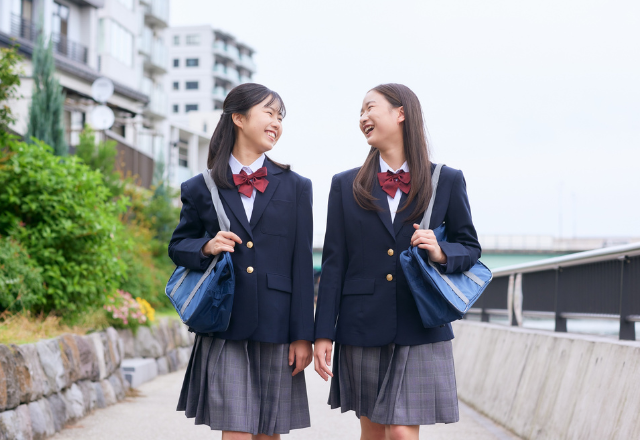
Girls wear the Western-inspired sailor uniform. This includes a sailor-collared blouse, pleated skirt, and a necktie or ribbon as an accessory. Some modern styles allow for customization of skirt length and optional accessorization. Knee-high socks are often worn with black/brown loafers, sneakers, Mary Janes, or flats. Similar to boys, girls wear indoor shoes (uwabaki)inside the school to prevent the floors from getting dirty.
Japanese Middle School Uniforms
Boy Uniforms

Middle school boys wear a navy or black military-style jacket with a high-standing collar. The jacket is typically adorned with gold buttons. Boys were matching straight-leg trousers to their jacket color. A white undershirt is typically worn beneath the jacket. For shoes, black or dark brown loafers or sneakers are standard attire.
Girls Uniforms
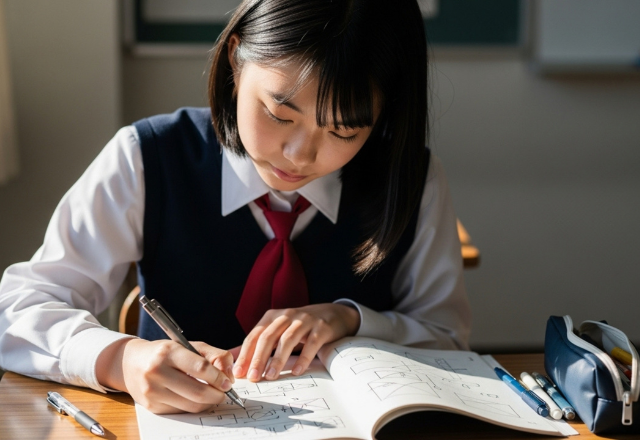
Middle school girls wear a navy-blue sailor blouse with pleated skirts. Some uniforms favor blazers with ties and ribbons and plaid skirts instead of pleated. Girls typically wear knee-high socks in white or in the color of their uniform and wear black or brown loafers or sneakers for footwear.
Elementary School Uniforms
Boys Uniform

Elementary school boys typically wear a button-up shirt or a polo. This is usually paired with navy-colored shorts or pants. Ankle- or knee-length socks are also commonly worn. When walking to school, a yellow cap is often worn for safety. Many schools also have randoseru, a box-shaped backpack worn by elementary students and usually in bright colors, serving a similar function to the safety hats.
Girls Uniforms
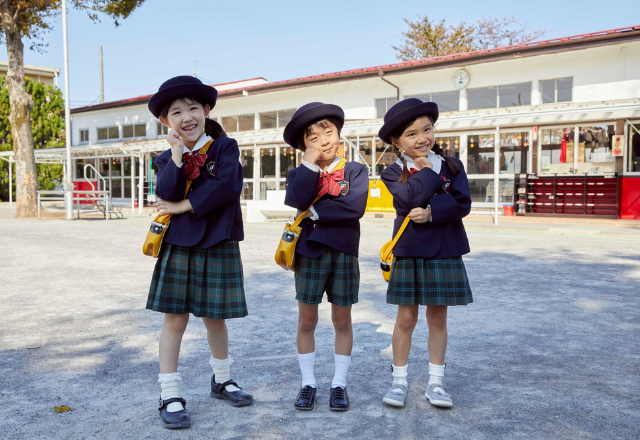
Elementary school girls’ uniform consists of a navy-colored sailor blouse with a matching colored cardigan. The collar is usually in the sailor or Peter Pan style. Long, pleated navy skirts are worn, as are ankle- or knee-length white socks. Similar to boys, elementary school girls also wear a yellow cap to school for safety purposes and are typically given a randoseru by their school.
Seasonal Variations of Uniforms
Depending on the current season, school uniforms may differ slightly in appearance to improve comfort and practicality. Koromogae is the formal term for changing clothes according to the season.
June 1 marks summer to winter, and October 1 marks winter to summer. Koromogae is not just about switching clothing items but also about properly cleaning and storing previous garments.
When it comes to school uniforms, parents will thoroughly clean the old uniforms and prepare the newer ones for use. In Japan, many schools have a week-long period between the shifting seasons when students can choose either winter or summer. to wear before fully transitioning.
For the warmer months, school uniforms are lighter and airier to match Japan’s hot and humid summer months. Boys’ uniforms typically consist of short-sleeve polo shirts and lighter trousers. For girls, their uniforms are short-sleeved blouses and shirts, more breathable and lighter skirts, vests, and occasionally polo shirts. Socks for both boys and girls are typically ankle-length instead of knee-length during the warmer months.
When the weather gets colder, Japanese school uniforms adjust to the season by favoring heavier and warmer materials. Boys’ winter uniforms consist of a blazer or jacket (typically made of wool) to stay warm and thicker matching trousers of the same color. Vests and cardigans are also sometimes worn for additional warmth. Wearing gloves is also common in the winter, and although it is not required, the gloves typically match the school uniform. The girls’ school uniforms in the winter usually involve wearing a warm blazer and knit vests. Thicker skirts are worn during the cold weather, sometimes with additional layers, and tights are permitted during the winter in many schools.
Curious how to use relevant phrases during Japanese seasons? Check out our article detailing Japanese seasonal vocabulary.
Cultural Significance of Japanese School Uniforms
The Japanese school uniforms have become staples in pop culture, not just in Japan but around the world. Several factors have contributed to these uniforms’ widespread recognition.
Japanese School Uniforms in Anime
Most notably, with the rapid rise in anime popularity in the 1990s and 2000s, many iconic characters were depicted wearing school uniforms. Usagi Tsukino (Sailor Moon), Shinji, Asuka, and Rei (Neon Genesis Evangelion), and Yusuke Urameshi (Yu Yu Hakusho).
All three of these anime were widely popular not just in Japan, but with overseas audiences as well. The most influential in terms of popularizing the school uniform is likely Sailor Moon. As even people who have not watched the anime know the iconic (yet embellished) school uniform she wears and has become synonymous with.
Since the 1990s and early 2000s, there has been a vast array of anime made that feature characters wearing school uniforms. While many of these depictions take creative liberties to add individualism to each character, the overall theme of sailor-style for girls and military-style for boys typically remains the same. If you want to practice your Japanese while watching anime, check out our recommendations for the best anime to watch to learn Japanese.
Japanese School Uniforms in Fashion
Another reason for the popularity of Japanese school uniforms worldwide is their influence on fashion. The designs of these uniforms make a statement and leave a lasting visual impression. As they are stylistically unique when compared to uniforms in other countries. The sailor and military styles are visually striking, and their historical roots, as they emerged during the Meiji Era, add further depth to their importance in Japanese culture. Many Japanese celebrities, singers, and bands have done their own variations on school uniforms and customized them to match their aesthetic.
These uniforms are inherently tied to youth culture in Japan, represent life and vitality, and combine support for conformity with rebellion. For instance, subcultures of the 1990s, such as tsuparri and gyaru had their own interpretations of school uniforms for boys and girls, respectively.
Tsuparri was a popular style among high school boys in the 1980s and 90s, and it rebelled against Japanese conformity. Taking inspiration from rock-and-roll and greaser culture in the United States at the time. Key elements of this style include pompadour hair and baggier, messier versions of the gakuran-style school boy uniform. The style became associated with delinquents by older adults and was vilified by mainstream media for its non-conformist look and deviation from Japanese standards for school attire.
The gyaru style was another fashion that emerged after tsuparri and rebelled against Japanese standards of conformity. With a focus on girls’ fashion instead of boys. Gyaru was popular in the late 1990s and early 2000s among Japanese high schoolers and young adults. With signatures of the style being spray-tanned skin, bleached hair in creative and funky styles, bold and colorful makeup, animal prints, studded belts, leg warmers, stylistic crop tops and mini skirts, and tons of accessorization to name a few.
Gyarus had their own interpretations of school uniforms, favoring short skirts, rolled-down socks, additional bows and accessories, platform shoes, and dramatic makeup and hairstyles. This style emerged from kogal culture. Which is similar to gyaru stylistically but with a focus on customizing school uniforms for girls who are in high school.
Rules Students Must Follow for Japanese Uniforms
In a country synonymous with rules and order, it is no surprise that there are strict rules that Japanese students must follow regarding their appearance at school. Here is a list of some rules that you may not know Japanese students have to abide by:
1. Hair color must be natural, and dye is not allowed. Proof of natural hair color is also required in some schools.
2. Makeup and nail polish are prohibited
3. Jewelry and piercings are not allowed
4. Long hair must be tied neatly into a ponytail or bun
5. Skirts must be knee-length
6. Boys’ hair must remain short
7. Socks can only be black or white
It is important to know that while Japan’s rules regarding student appearance are still widely representative of the Meiji Era standards, certain schools, particularly in Tokyo, are easing some of these rules and becoming more flexible.
Interested in learning more about Japanese rules? Check out our article on things you shouldn’t do in Japan.
Conclusion
Japanese school uniforms have become a compelling window into Japan’s traditions, values, and modern society.
If you’ve fallen in love with Japan, there is no better way to truly experience the culture than by living it firsthand. Learning the language opens the door to deeper connections and interactions — and studying in Japan is one of the most effective and accessible ways to achieve that goal!
Come to Japan with Coto School Finder’s Free Support!
Ready to study Japanese in Japan? Coto School Finder is here to support you every step of the way. As a study abroad service partnering with a trusted language school, the team helps you compare programs that match your goals, and guides you through the application and student visa process — all for free!
Take the next step toward your future in Japan. Let us help you make your dream of living and studying in Japan a reality. Find a language school today and get started.
What are the rules for school uniforms in Japan?
There are quite a few rules for school uniforms in Japan. Gakuran is the standard uniform for schoolboys, and seifuku is the standard uniform for schoolgirls. Boys wear military-style outfits while girls wear sailor-style blouses.
What are Japanese school uniforms based on?
Japanese school uniforms are based on British naval and military styles that were commonplace during the Meiji Era. Since Britain possessed one of the most powerful military forces on the planet, these uniforms became synonymous with strength. This is one of the reasons Emperor Meiji implemented them in Japan.
Why do Japanese people wear school uniforms?
There are a variety of reasons why Japanese people wear school uniforms. These uniforms are enforced in schools to promote conformity and unified groups, emphasize collective strength, put all students on a fair and equal playing field, and create a sense of discipline.
What is a Japanese school uniform called?
For boys, a Japanese uniform is called a gakuran, and for girls, their uniform is called a seifuku. The boys’ style is derived from European military outfits, while the girls’ outfits are reminiscent of European naval outfits.
How strict is the Japanese dress code?
The Japanese dress code is quite strict by its standards, although it has slowly become less stringent over time, particularly in cities such as Tokyo. In general, however, Japanese dress codes encompass many aspects, from hair length, accessories, hair color, outfit length, and outfit style.