



If you’re thinking of living and working in Japan, you are probably wondering what the average salary here is. A quick Google search will show you that the average salary is much lower than in other larger economies, such as the United States and many EU nations.
However, we still need to consider the average salary alongside other factors, such as the cost of living and salaries in specific regions. Now, let’s find out what you can expect your salary to be when you move to Japan!
Recent Trends for Japan’s National Average Salary
Japan’s average annual salary is around 4.78 million JPY (about $30,650), according to a 2024 survey by the National Tax Agency(NTA), the latest survey published using national data. The survey included all salaried workers, which number around 67 million. It also found that wages grew about 3.9% from the previous year, the 4th consecutive year wages have risen. It’s also the highest wage growth Japan has observed since 1991. Additionally, the average bonus rose to ¥750,000, the first increase in 2 years.
So, contrary to historical trends, average salaries in Japan have actually been rising in recent years and are outpacing inflation. But let’s break it down further: the table below shows average wages by gender and employment type, divided by average salary and year-on-year growth.
| Average Salary | Year-on-Year Growth | |
|---|---|---|
| Male | ¥5,870,000 | 3.2% |
| Female | ¥3,330,000 | 5.5% |
| Full-time Employee | ¥5,450,000 | 3.2% |
| Temporary Employee | ¥3,330,000 | 5.5% |
| Overall | ¥4,780,000 | 3.9% |
According to the survey, when you break down the income distribution, the largest group for men had incomes above ¥4 million and up to ¥5 million. The largest income group for women is above ¥2 million and up to ¥3 million. This seems close to the national average; however, let’s compare Japan’s average salary to other nations.
Japan’s National Average Salary vs Other Nations
Japan’s national average salary is low relative to other countries, as the table below shows. Based on the OECD’s average annual wages, Japan’s wage is equal to around $50,183 adjusted for purchasing power parity (PPP). This is much lower compared to the OECD average ($64,809) and large nations like the US ($86,977).
However, it’s still important to consider the cost of living; for instance, the total daily expenditures in the United States could be 2 to 3 times Japan’s. Japan’s salary doesn’t need to be as high since living expenses tend to be lower. Based on the Price Level Index by the World Bank, which ranks how expensive a country is. An index above 100 indicates that a nation is more expensive, with higher overall prices. So, Japan has a lower Price Level Index than the United States and Canada but is still higher than some advanced European countries like Germany, the UK, and France.
We also compared the price of a McDonald’s Big Mac between these countries, which can offer a decent, albeit imperfect, idea of how expensive a country is since Big Macs are very consistent across countries. The price of a Big Mac in Japan is the lowest on the list below, more than 2 times lower than in the US, Germany, the UK, and France.
Additionally, average rent prices are much lower in Japan than in most other nations. The average monthly rent in Japan is around $376–$565; in the US, by comparison, it’s around $1,500–$2,000, and in France, around $522-$1,740.
| Country | Avg. Annual Salary (PPP-adjusted USD)¹ | Price Level Index (World Avg. = 100) | Big Mac Price (USD) |
|---|---|---|---|
| Japan | $49,446 | 142.5 | $3.08 |
| United States | $82,933 | 158.5 | $6.22 |
| Germany | $69,433 | 131.6 | ~$7.00 |
| Canada | $69,417 | 149.1 | $5.81 |
| United Kingdom | $63,691 | 140.5 | $7.05 |
| France | $60,608 | 128.5 | ~$7.00 |
Average Salary and Minimum Wage by Region
Just like industry and age, where you work in Japan makes a real difference in your take-home pay. According to the same 2025 Basic Survey on Wage Structure, only four prefectures pay above the national average monthly salary of ¥398,000: Tokyo, Kanagawa, Aichi, and Osaka. Tokyo leads by a decent margin at ¥418,300 per month, nearly ¥20,000 above the national average.
The remaining 43 prefectures all fall below the national average, highlighting how concentrated Japan’s higher-paying jobs are in its major metropolitan areas.
Minimum Wage by Region
Minimum wage also varies significantly by prefecture, since Japan sets it regionally rather than nationally. This is especially important if you’re a student who wants to work part-time in Japan. According to MHLW’s 2025 Regional Minimum Wage, here’s how it breaks down:
| Prefecture | Minimum Wage (Hourly) |
|---|---|
| Tokyo | ¥1,280 |
| Kanagawa | ¥1,279 |
| Osaka | ¥1,177 |
| Saitama | ¥1,196 |
| Chiba | ¥1,195 |
| Aichi | ¥1,195 |
| Kyoto | ¥1,180 |
| National weighted average | ¥1,177 |
| Miyazaki (lowest) | ¥1,085 |
The national average is currently ¥1,177 as of October 2026, but the minimum wage in all prefectures rose from the previous year. Tokyo has the highest minimum wage and is almost ¥200 higher than the lowest prefecture at ¥1,085, which can create huge differences in annual income based purely on location.
The Average Japanese Salary by Age
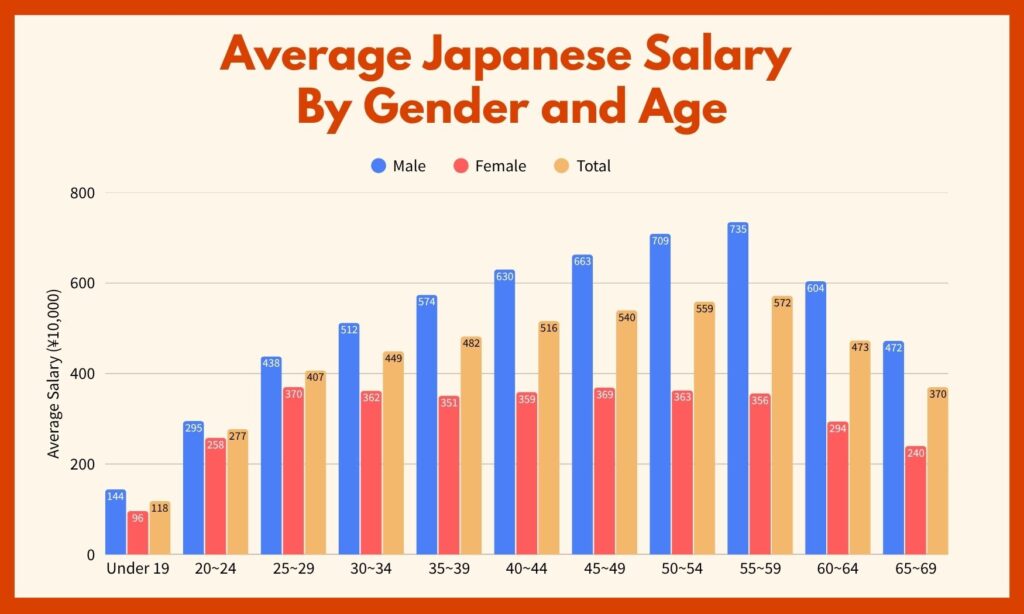
The average Japanese salary varies greatly by age, as shown in the infographic above, using data from the NTA. The chart is separated by gender and shows that both male (blue bars) and overall wages (yellow bars) tend to grow as workers get older. Wages also tend to peak for men around ages 55~59 before dipping after 60, which is Japan’s retirement age.
However, this is not true for women; average wage growth is virtually nonexistent once women are past the 25~29 age group. Average wage growth actually decreases for women in the 30~34 and 35~39 age groups. But wages never seem to grow much, as shown by the red bars, which stay roughly the same size, and then steadily decline after women are 50.
So, the income gap between males and females is quite noticeable. So, what does this mean if you’re planning to work in Japan? Will your gender determine your wage?
Why Is There a Gap Between Male & Female Wages
According to the OECD, the gap between median female and male wages in Japan is 20%, twice the OECD average of about 10%. This shows Japan has a steep gender wage gap, even compared to other advanced countries.
Based on a 2026 report by Equileap, women rarely hold senior positions in companies, with only 1% of CEOs and 4% of CFOs in Japan being female. They also make up a very small share of executive teams and board members. This clearly shows that women are not getting opportunities to advance their careers.
The reasons could be varied, such as women having to take maternity leave for pregnancy and childbirth. Companies may be less likely to offer promotional opportunities to women if they anticipate maternity leave. It’s also possible that Japanese society still expects women to take on more family or household responsibilities, leading them to work fewer hours and receive less consideration for certain assignments and promotions.
However, things are improving: women’s average wages increased by 5.5% compared to last year, which also saw over 3% growth. This is the first time in 33 years that women’s wages have grown by over 3% for 2 consecutive years, according to the Asahi Shimbun.
The 2026 Equileap report also showed that Japan’s policy requiring companies to report wage gaps has been effective, with 94% of companies disclosing pay gap data. Additionally, a paper by the Research Institute of Economy, Trade, and Industry (RIETI) suggests foreign investment may be pressuring companies to achieve greater workplace equality between genders.
Average Salary and Minimum Wage by Region
Just like gender and age, where you work in Japan makes a real difference in your take-home pay. According to the same 2025 Basic Survey on Wage Structure, only four prefectures pay above the national average monthly salary of ¥398,000: Tokyo, Kanagawa, Aichi, and Osaka. Tokyo leads by a wide margin at ¥418,300 per month, nearly ¥78,000 above the national average.
The remaining 43 prefectures all fall below the national average, highlighting how concentrated Japan’s higher-paying jobs are in its major metropolitan areas.
Minimum Wage by Region
Minimum wage also varies significantly by prefecture, since Japan sets it regionally rather than nationally. This is especially important if you’re a student who wants to work part-time in Japan. According to MHLW’s 2025 Regional Minimum Wage, here’s how it breaks down:
| Prefecture | Minimum Wage (Hourly) |
|---|---|
| Tokyo | ¥1,280 |
| Kanagawa | ¥1,279 |
| Osaka | ¥1,177 |
| Saitama | ¥1,196 |
| Chiba | ¥1,195 |
| Aichi | ¥1,195 |
| Kyoto | ¥1,180 |
| National weighted average | ¥1,177 |
| Miyazaki (lowest) | ¥1,085 |
The national average is currently ¥1,177 as of October 2026, but the minimum wage in all prefectures rose from the previous year. Tokyo has the highest minimum wage and is almost ¥200 higher than the lowest prefecture at ¥1,085, which can create huge differences in annual income based purely on location.
Average Salary by Field of Work
Beyond age and gender, the industry you work in makes a huge difference in your paycheck in Japan. According to the Ministry of Health, Labor, and Welfare’s (MHLW) Basic Survey of Wage Structure, average salaries range drastically across industries. This is no surprise; some work is more skill-intensive, requires more education/training, and is in higher demand, so it pays more.
Let’s break down how the numbers stack up when comparing different employment sectors in Japan.
| Industry | Regular Employee Salary | Non-Regular Employee Salary |
|---|---|---|
| Electricity, Gas, Heat & Water Supply | ¥453,700 | ¥294,300 |
| Academic Research, Professional/Technical Services | ¥453,100 | ¥326,000 |
| Finance & Insurance | ¥444,800 | ¥300,700 |
| Information & Communications | ¥411,000 | ¥333,800 |
| Education, Learning Support | ¥396,700 | ¥270,400 |
| Mining, Quarrying & Gravel Extraction | ¥388,300 | ¥388,400 |
| Real Estate & Goods Rental | ¥380,100 | ¥241,900 |
| Wholesale & Retail | ¥374,400 | ¥229,500 |
| Construction | ¥370,900 | ¥300,100 |
| Combined Services | ¥349,800 | ¥236,600 |
| Manufacturing | ¥346,100 | ¥229,400 |
| Medical, Healthcare & Welfare | ¥325,500 | ¥242,800 |
| Transport & Postal Services | ¥324,600 | ¥236,900 |
| Life-Related & Entertainment Services | ¥320,100 | ¥214,000 |
| Other Services | ¥312,100 | ¥238,600 |
| Accommodation & Food Services | ¥303,800 | ¥211,600 |
The highest earners are employees in energy, academic research & professional/technical services, finance & insurance, and IT sectors. Each of these fields usually needs highly trained or educated professionals, which is likely why they boast higher salaries. On the other end, accommodation and food services sit at the very bottom. This industry also relies heavily on part-time and non-regular staff who generally earn lower wages.
So, you might consider entering utilities, finance, professional services, or IT to earn the highest wages. But keep in mind, these figures include everyone in each industry, from entry-level part-timers to senior executives, so your actual salary will still depend heavily on your role, experience, and the specific company you work for.
It’s also worth noting that foreign workers might be less likely to work in certain fields and more likely to work in others. For instance, many foreigners tend to enter education, manufacturing, and healthcare.
Average Salary for Foreigners vs Native Born Workers
According to the Ministry of Health, Labor and Welfare’s (MHLW) Basic Survey on Wage Structure, foreign workers in Japan earn an average monthly salary of ¥254,300, noticeably below the average for Japanese workers overall, which sits around ¥398,000 per month based on the 2024 NTA survey.
This gap largely comes down to the types of jobs foreign workers tend to hold, the industries they work in, and, as you’ll see below, visa status and language ability, rather than a simple case of foreign workers being paid less for identical work.
How Does Visa Status Affect Salary?
Visa status is one of the biggest single factors in salary in Japan. The same MHLW survey breaks down monthly wages by residence status category:
| Visa/Residence Status | Average Monthly Salary | YoY Change |
|---|---|---|
| Professional/Technical fields (excluding Specified Skilled Worker) | ¥313,200 | +7.3% |
| Status-based residence (e.g., permanent resident, spouse of Japanese national) | ¥311,100 | +3.6% |
| Specified Skilled Worker (特定技能) | ¥221,400 | +4.8% |
| Other (e.g., Designated Activities, work outside student visa limits) | ¥228,300 | +0.8% |
| Technical Intern Trainee (技能実習) | ¥190,300 | +4.2% |
| All foreign workers (average) | ¥254,300 | +4.8% |
The pattern here is clear: workers with professional/technical work visas or long-term residency statuses, like permanent residents, earn the most. Workers with professional/technical skills engage in more specialized, higher-paid fields and often aren’t restricted by industry, while status-based residents aren’t tied to a specific employer or narrowly defined job scope.
On the other end, Technical Intern Trainees earn the least by a wide margin, reflecting both the lower-skilled nature of many of these positions and the more restrictive terms of that visa category.
How Does Japanese Ability Affect Foreign Workers’ Salaries?
This is where the data gets especially interesting. In 2024, MHLW conducted a special analysis on foreign wages and self-reported Japanese ability based on the 2024 Survey on the Employment Conditions of Foreign Workers. The results showed a clear, consistent pattern: the better someone’s Japanese, the more they earn, and this holds true for both conversational and reading ability.
| Japanese Speaking Level | Average Monthly Salary | JLPT Reading Level | Average Monthly Salary |
|---|---|---|---|
| Native level | ¥341,265 | Native Level | ¥353,605 |
| Fluent level | ¥328,365 | N1 | ¥347,683 |
| Able to speak in most situations | ¥288,830 | N2 | ¥297,200 |
| Able to participate in long conversations | ¥277,588 | N3 | ¥270,124 |
| Can speak about familiar topics | ¥259,941 | N4 | ¥246,884 |
| Can speak in short conversations | ¥256,142 | N5 | ¥243,505 |
| None | ¥288,392 | None | ¥270,320 |
Conversational ability showed the same trend, with workers who described themselves as capable of native-level conversation earning around ¥341,265 per month, compared to roughly ¥256,000-259,000 for those who could only manage basic greetings or simple conversations.
The MHLW itself flagged an important caveat in its report. This isn’t necessarily proof that learning Japanese directly causes a pay raise; jobs requiring advanced Japanese (like specialized technical or professional roles) tend to pay more to begin with. So the relationship reflects both individual language ability and the fact that higher-paying jobs simply demand higher Japanese proficiency as a baseline requirement.
Japan’s Average Median Salary
It’s actually important to also take a look at the median salary of a nation, since the median won’t be influenced by outliers. For example, if a country has very few, but very rich individuals (like billionaires), while the vast majority doesn’t make nearly as much, that could skew the average salary much higher than what a mid-level employee could expect to make. So, how does Japan’s median salary compare to other countries?
The median salary is around ¥3.51 million according to a MUFG report using data from the Ministry of Labor, Health, and Welfare and the NTA survey of Private Sector Wages. This is lower than the average wage, which sits at ¥4.78 million and is pulled up by higher-wage earners.
The average can be misleading because of outliers, so the median may better reflect the wages of an average employee in Japan.
Conclusion: Average Salary in Japan May Be Lower, But Costs Are Too
Compared to other nations, Japan has a much lower average salary; however, living costs are also lower, so these wages are very livable, but that doesn’t mean you should lowball yourself either! Additionally, your wage depends heavily on the industry you enter, the type of work you do, and how much Japanese you speak. While gender and foreign wage gaps still exist, Japan is steadily improving its working conditions, and it is very possible to earn a higher wage here despite what averages may say!
Find the Perfect School to Learn Japanese and Live in Japan
Many of the higher-paying jobs in Japan require high Japanese skills, so find the perfect skill to prepare you for a career in Japan with Coto School Finder! We will help you find the perfect language school for your needs and preferences. We will support you from the school to visa applications, all for free!
Fill out the form to get started, and we’ll reach out to set up a casual chat!
FAQ:
What's the difference between "regular" and "non-regular" employees in Japan?
Regular employees (正社員・正職員) are full-time staff with open-ended contracts, while non-regular employees include part-time, contract, and temporary workers.
What is the average salary in Japan?
The average salary in Japan is 4.78 million JPY (about $30,650), but this figure can be skewed by outliers, such as a minority of very high-income earners. So, it’s worth considering the median wage instead which is around ¥3.51 million.
What jobs pay the most in Japan?
Generally, management and executive positions pay the most, but certain fields and job types in energy, professional/technical services, finance, and IT tend to pay well.
Is the Japanese salary lower compared to other countries?
Japanese salaries are lower compared to the US and most advanced Western nations; however, Japan does have a much lower cost of living, especially for rent, so this makes up for the lower salary and may even allow for savings.
You May Be Interested in:
Switching from a Student Visa to a Work Visa in Japan: Step-by-Step Guide
How to Get a Job-Hunting Visa in Japan (2026 Guide)
How to Switch from a Working Holiday Visa in Japan – A Guide
2026 Study in Japan Guide: Japanese Student Visa Application