

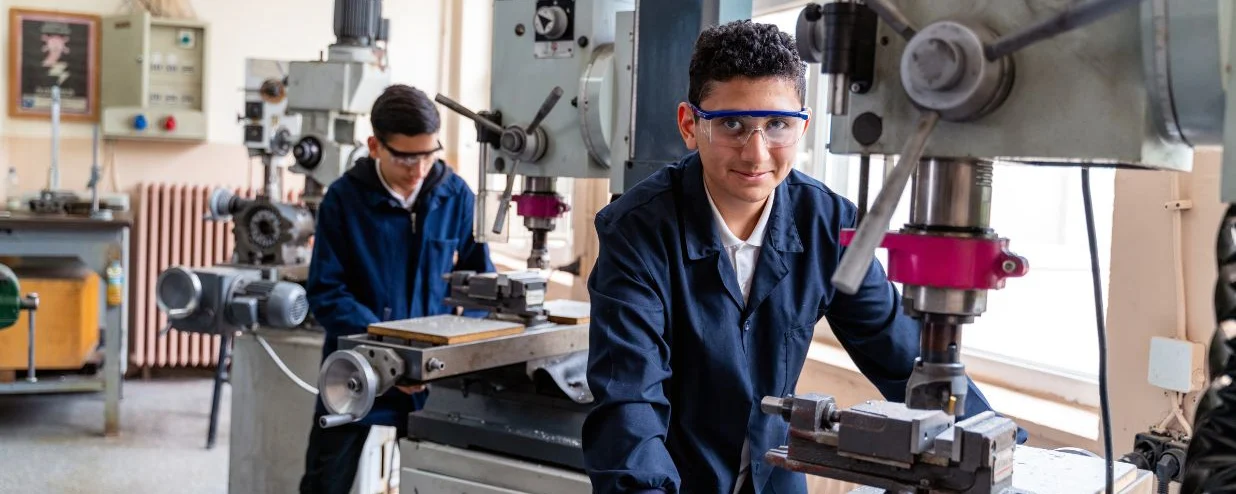

While many young people choose university as their choice of higher education, others opt for trade or vocational schools because they offer a more specific, direct path to employment. In Japan, this is not a small group. According to JASSO’s 2025 survey, 106,829 international students were enrolled in a senmongakkou (専門学校, vocational school) as of May 2025, up nearly 40% from the year before.
This is a big reason why many foreigners in Japan go to a senmongakkou right after finishing Japanese language school instead of heading to university. It’s a great option if you already know the career or trade you want to grow in, whether that’s hospitality or even anime. But how do you actually get into a senmongakkou? What’s the roadmap, and what should you know before you apply?
In this article, we’ll cover:
- What senmon gakkou are and how they differ from universities
- The types of careers they prepare you for
- Admission and language requirements
What is Senmongakkou, or Japanese Vocational School?
In the Japanese education system, senmon gakkou are professional training colleges in Japan that offer specialized programs in fields such as:
- IT and engineering
- Healthcare and nursing
- Fashion and design
- Game development and animation
- Business and marketing
- Culinary arts
Senmongakkou (専門学校) combines “senmon” (専門, specialty) and “gakkou” (学校, school), so it literally means “specialized school.”
These schools focus on hands-on training, preparing students to enter the workforce with real, applicable skills.
Most of the Senmon Gakkou programs are conducted in Japanese, and proficiency in the language is a key requirement. Some institutions may offer courses in English, but these are often limited.
As of 2026, there are around 2,800 vocational colleges in Japan, categorized as professional training colleges. These institutions are regulated by the Ministry of Education (MEXT) and are designed to fill specific gaps in the Japanese workforce.
How is Senmongakkou Different from Japanese Universities?
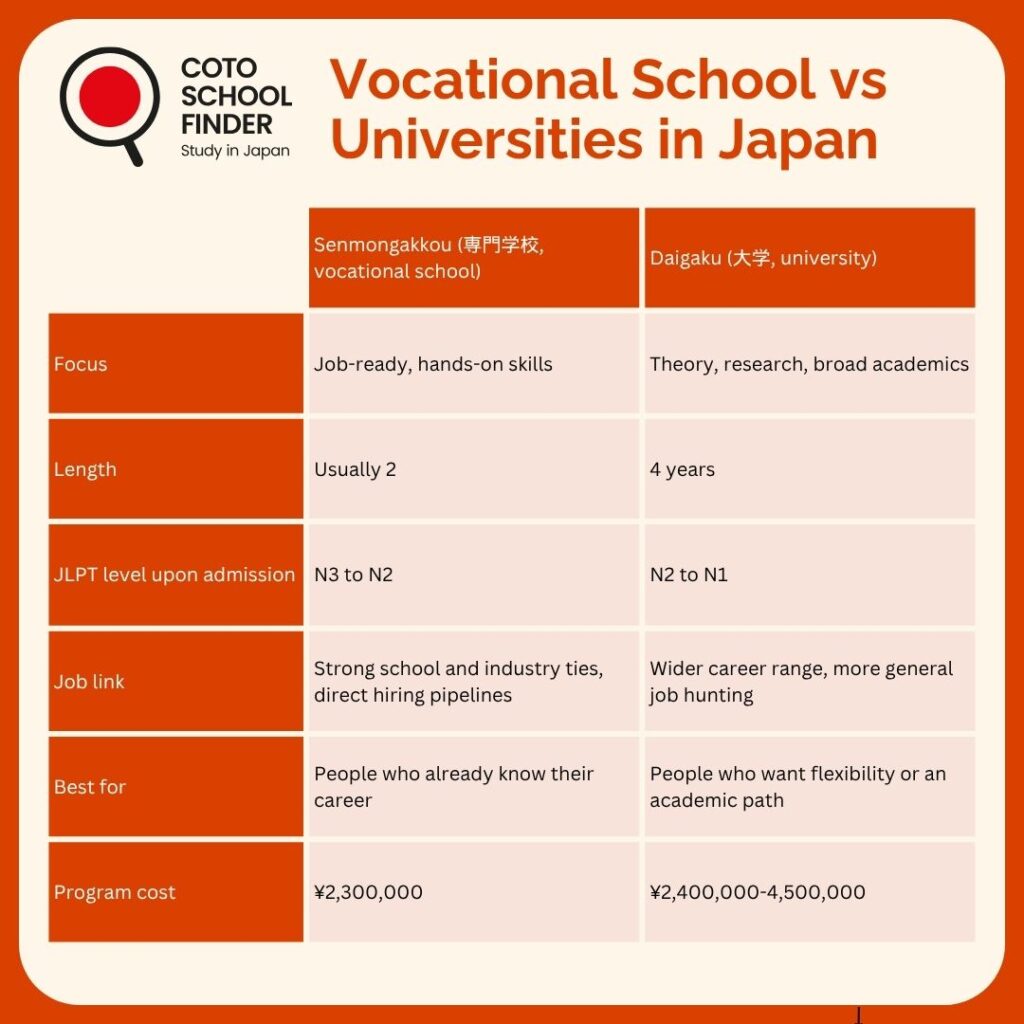
| Senmongakkou (専門学校, vocational school) | Daigaku (大学, university) | |
|---|---|---|
| Focus | Job-ready, hands-on skills | Theory, research, broad academics |
| Length | Usually 2 | 4 years |
| JLPT level upon admission | N3 to N2 | N2 to N1 |
| Job link | Strong school and industry ties, direct hiring pipelines | Wider career range, more general job hunting |
| Best for | People who already know their career | People who want flexibility or an academic path |
| Program cost | ¥2,300,000 | ¥2,400,000-4,500,000 |
Vocational school and a university differ in many ways from budget, focus, timeline, and duration.
A vocational school often offers a 2-year program of focused training in the skill you’re going for, while a university is typically 4 years (unless you graduate early or extend). This is also why a senmongakkou is often seen as “cheaper”: it’s simply two years instead of four.
In terms of their programs, vocational schools in Japan almost always focus on ready-to-work skills, while Japanese universities, like many around the world, lean toward theory and academic research. Some university majors are also so broad that you have to narrow down your focus later. A senmongakkou typically offers more straightforward skill training.
That’s not to say a senmongakkou is all blue-collar work. In fact, many vocational schools in Japan focus on game development, IT, anime, arts, hospitality, and so much more.
What’s great about a senmongakkou is that it lets you channel your passion directly. If you love drawing and anime, you can train in a program built around exactly that.
You may also hear that a senmongakkou is “for people who can’t afford university” or is a backup for those who didn’t get in. That’s a common and outdated notion, and it isn’t really true. Per year, a senmongakkou often costs more than a national university, and the shorter timeline is what brings the total down. Many students pick one on purpose, because they know exactly what career they want and would rather skip the extra two years of general study.
The negative notion also ignores what you get: hands-on training, industry connections, and a faster start to your career. The better question is not which school looks better on paper, but which one fits the path you want.
Key Features of Senmon Gakkou
Practical Focus: Senmon Gakkou emphasizes hands-on, practical training over theoretical knowledge. This approach equips students with the skills and expertise needed for their chosen careers. Less theory, more real-world practice
Industry-Relevant Curriculum: Programs are tailored to meet the specific demands of industries such as technology, healthcare, design, business, and more. The curriculum is often developed in collaboration with industry professionals to ensure its relevance. Often developed with input from professionals.
Shorter Duration: Compared to traditional universities, Senmon Gakkou programs are typically shorter in duration, ranging from one to three years. This allows students to enter the workforce more quickly and start contributing to their chosen fields.
Specialized Degrees: Graduates of Senmon Gakkou receive specialized degrees or diplomas, indicating their expertise in a particular field. This focused education enhances their employability in the job market.
Job Placement Assistance: Many Senmon Gakkou institutions have strong connections with industry partners. They often provide job placement assistance, internships, and networking opportunities to help students transition smoothly into the workforce.
Flexible Admission Requirements: While academic achievements are considered, Senmon Gakkou often values practical skills and passion for the chosen field. This flexibility allows individuals with a range of backgrounds to pursue their desired careers.
Small Class Sizes: Class sizes are generally smaller compared to universities, fostering a more personalized learning environment. This allows for greater interaction between students and instructors, facilitating a more effective learning experience.
How to Apply to a Senmongakko in Japan
The process of entering a Japanese vocational school is simpler than applying to a university, but it still takes planning.
You must first start by choosing the field, not the school. Know the job you’re aiming for, then look for schools that train for it. Most programs begin in April, and many schools accept applications from early autumn through winter, so aim to start your search about a year ahead.
If you’re considering senongakko or vicational school in Japan, the often typical path is to first spend 1-2 years a ta Japanese language school before you enter.
Next, check the requirements. Schools usually ask for 12 years of formal education and proof of Japanese ability. Many programs expect around JLPT N2 (日本語能力試験, Japanese Language Proficiency Test), though some accept N3 and a few ask for more. Requirements differ a lot between schools and fields, so always confirm on the school’s own admissions page.
Then visit if you can. Most schools hold open campus days (オープンキャンパス, Oopun Kyanpasu, school visit events) and info sessions. They are the best way to see the facilities, meet teachers, and ask about support for international students.
When you apply, expect an application form, school transcripts, a graduation certificate, and proof of Japanese ability. Unlike Japanese universities, you do not need to pass the EJU. For some programs you’ll also need an interview, a short essay, or a portfolio, which is common for art, design, and anime courses. Many schools offer AO admission (AO入試, AO Nyuushi, a screening based on motivation and personality rather than a written exam), which is popular with international students.
Once you’re accepted, you pay the admission fee and first-term tuition by the deadline. If you’re applying from overseas, the school will usually help you apply for a Certificate of Eligibility (在留資格認定証明書, Zairyuu Shikaku Nintei Shoumeisho, the document you need for a student visa). If you’re already in Japan from language school, you’ll switch your visa status instead, so ask the school’s international office how it handles this.
Finding the Right Senmongakkou for You
If you’re already at a Japanese language school, the administration team usually has a network of vocational schools they can recommend. We suggest you first decide what you want to study. Is it hospitality? Anime? IT?
From there, bring it up with your homeroom teacher. Many Japanese language schools, especially ones focused on helping students enter higher education, have a great support system, like the schools on Coto School Finder. You can also do your own research and ask schools for brochures and open campus dates.
One thing to note: don’t use a vocational school as a way to bypass or cheat the immigration system. Use it to actually learn and develop the skill you want.
Benefits of Attending Senmon Gakkou
1. Immediate Applicability
Senmon gakkou graduates are prepared to enter the workforce immediately upon completing their programs, armed with practical skills that directly apply to their chosen professions.
2. High Employability:
Employers value the practical training received at Senmon Gakkou, making graduates highly sought after in the job market. The specialized nature of their education enhances their competitiveness in specific industries.
3. Cost-Effective Education:
The shorter duration of programs at Senmon Gakkou often translates to lower overall education costs compared to traditional universities. This makes it an attractive option for those seeking a more cost-effective pathway to a career.
Considerations for Prospective Students
Research and Specialization
Prospective students should thoroughly research Senmon Gakkou institutions, considering factors such as program offerings, faculty expertise, industry connections, and job placement rates.
Language Proficiency
As mentioned previously, proficiency in the Japanese language is crucial for success in senmon gakkou. International students may need to meet specific language requirements or consider language schools for language preparation. Our team at Coto School Finder will help you find the perfect language school catered to your needs and goals for free!
Admission Process
Understand the admission requirements and application process for each Senmon Gakkou. This may include submitting academic transcripts, letters of recommendation, and, in some cases, undergoing interviews.
Financial Planning
While Senmon Gakkou can be more cost-effective than traditional universities, it’s essential for prospective students to plan their finances, considering tuition fees, living expenses, and potential part-time work opportunities.
Visit Campuses
Whenever possible, visit the campuses of Senmon Gakkou to get a feel for the environment, facilities, and overall atmosphere. This can play a significant role in making an informed decision.
Senmon gakkou in Japan represents a dynamic approach to education, offering a direct pathway to specialized careers. Understanding the nuances of these vocational schools is crucial for those aspiring to thrive in Japan’s competitive job market.
New Visa Regulations for Vocational Graduates from 2024
Before February 2024, vocational school graduates faced strict job restrictions where it has to closely match what you studied, and many graduates struggled to find work in Japan or left the country.
Japan’s Immigration Services Agency changed these rules in February 2024. Now, senmongakkou graduates can apply for a work visa under the same category as university graduates, the “Engineer/Specialist in Humanities/International Services” status (技術・人文知識・国際業務, Gijutsu Jinbun Chishiki Kokusai Gyoumu), as long as they can demonstrate Japanese proficiency. That means you can work in a job that isn’t a perfect match for your major.
The change was made to help address Japan’s labor shortage. It opens up more options in sectors that need workers, such as construction, elderly care, and hospitality. Students in fields like IT, international business, education, and welfare, who often had a hard time getting hired under the old rules, benefit as well.
Senmongakkou vs University: Which Should It Be?
At the end of the day, neither one is better than the other. Japanese universities are known to be some of the best in the world, and cost-wise there are affordable options if you get a scholarship or enter a public university. A senmongakkou, on the other hand, gets you job-ready skills in two years.
What matters is what you want to do in Japan for the long term. Think about this as soon as you start studying Japanese, even before you arrive, and have a clear plan from the start.
Plan Your Senmongakkou Path Starting With the Right Language School
Coto School Finder is a free school-matching service that helps you find a Japanese language school that fits your goals. Already know you want to go to a senmongakkou? We’ll match you with a school that builds the Japanese level you need, and guide you through the student visa process along the way.
FAQ
Can I work part-time while studying at Senmon Gakkou?
Yes, international students in Japan are generally allowed to work part-time during their studies, provided they adhere to visa regulations. However, it’s important to balance work commitments with academic responsibilities.
Are there scholarships available for international students at Senmon Gakkou?
Some Senmon Gakkou institutions offer scholarships to international students based on merit or financial need. Prospective students should check with the specific institution they are interested in for details on available scholarships.
Can international students apply to Senmon Gakkou, and what are their language requirements?
Yes, many Senmon Gakkou accept international students. However, applicants are typically required to demonstrate a certain level of proficiency in Japanese, often through standardized tests like the JLPT (Japanese Language Proficiency Test) or other language assessments.
What makes Senmon Gakkou different from traditional universities in Japan?
Senmon Gakkou focuses on providing practical, hands-on training in specific industries, aiming to equip students with skills directly applicable to their chosen careers. Traditional universities, on the other hand, offer a more general education.
What kind of support services does Senmon Gakkou provide to help students transition to the workforce?
Senmon Gakkou often collaborates with industry partners, providing students with internships, practical training, and job placement support opportunities. Career counseling services are also common to guide students in their career paths.