



New to Japan? Sooner or later, you’ll need to send something by post. Maybe it’s paperwork for your Japanese language school, or souvenirs for family back home. It’s easier than it looks. Japan’s postal system is fast and reliable, and with a little guidance, you’ll be mailing like a local. Here’s how to send mail in Japan.
In this guide, we’ll break it all down. From navigating the post office to choosing the right mailing service, we’ll even some handy phrases to make life easier. By the end, you’ll be ready to take on Japan’s postal world like a pro!
How Do You Ship Documents and Items in Japan? Understanding Japan’s Postal System
Japan has many private delivery companies, but Japan Post (日本郵便, Nihon Yubin) is the national postal service. Its post offices are all over the country, so it’s the main place to send general mail. If you’ve just arrived, you may already know the name, and you may even have an account there. Japan Post Bank (ゆうちょ銀行, Yuucho Ginko, “postal savings bank”) is one of the easiest banks for foreigners to open an account with.
Here’s a quick look at what they offer:
1. Regular Mail
Regular mail is for paper-based items like postcards, letters, and documents. The system works much like it does in most countries: put your letter in an envelope, buy a stamp that matches its size and weight, and drop it in a mailbox. That’s it.
2. Parcels
For larger packages, whether domestic or international, you can often choose between shipping by sea or by air. Air is faster but more expensive.
3. Express Services
EMS (Express Mail Service) is your go-to for urgent international deliveries.
Private Delivery Companies in Japan
Japan has three main players for parcels: Yamato Transport (ヤマト運輸, Yamato Unyu, “Yamato Transport”), Sagawa Express (佐川急便, Sagawa Kyubin, “Sagawa Express”), and Japan Post’s parcel service, Yu-Pack (ゆうパック, Yuupakku).
Yamato is the most popular with everyday customers, and you will see its black cat logo on trucks all over the country. Yamato is better known as Kuroneko (クロネコ, “black cat”), after its mascot of a mother cat carrying a kitten. Its main service is Takkyubin (宅急便, “home delivery service”), which delivers parcels door to door, usually the next day within the same region. Prices depend on the size of the box (the total of its length, width, and height) and the distance it travels. Yamato also offers Nekoposu (ネコポス, “cat post”), a cheaper option for small, flat items that fit in a mailbox, which is handy for online shop orders and small gifts.
Sagawa Express (佐川急便, Sagawa Kyubin) is another popular delivery company. It mainly handles business shipping, including many online orders. If a tracking email from an online shop mentions Sagawa, it is the same kind of door-to-door service.
Private carriers are known for flexible delivery. You can choose a delivery time slot (時間指定, Jikan Shitei, “specified time”), and if you miss the courier, you can book a new time (再配達, Saihaitatsu, “redelivery”) online, by app, or by phone. Many also offer cash on delivery (代金引換, Daikin Hikikae, “payment on delivery”), and some can keep food cold during shipping with refrigerated services.
Writing Your Address in Japanese
Addresses in Japan are written from the biggest area to the smallest, which is the opposite of what you may be used to. Here is a standard Japanese address.
〒150-0001
東京都渋谷区神宮前1丁目2番3号
パークビル202号室
田中太郎 様
| Japanese | Reading | Meaning |
|---|---|---|
| 〒150-0001 | None | Postal code (the 〒 mark means “postal”) |
| 東京都 | Tokyo-to | Prefecture |
| 渋谷区 | Shibuya-ku | City ward |
| 神宮前1丁目2番3号 | Jingumae 1-2-3 | Street address |
| パークビル202号室 | Paaku Biru, 202 Goushitsu | Building name and room number (Park Building, Room 202) |
| 田中太郎 様 | Tanaka Taro-sama | Recipient’s name with the respectful honorific 様 (sama) |
Use 様 (sama) after the recipient’s name, especially for formal mail. Note that Japanese names are written with the family name first.
For international mail, the order flips. You start with the recipient and end with the country.
Taro Tanaka
Park Building, Room 202
1-2-3 Jingumae
Shibuya-ku, Tokyo
150-0001
JAPAN
How to Send Mail Domestically and Internationally in Japan
Japan’s postal system is well integrated with everyday services, so you can often send mail and parcels within Japan from a convenience store instead of going to the post office.
Step 1: Get Your Stamp
Stamps are sold at post offices and, more conveniently, at some vending machines. If you are doing things last minute, many convenience stores also sell envelopes and letter packs, so you can get everything in one stop.
As mentioned earlier, the stamp you need depends on the size and weight of your mail. Heavier or larger items cost more, and anything over the limit for its category may need a different service.
In general, here is the price of the stamp you would need to get depending on the size and weight of your mail.
| Item | Price | Stamp needed? |
|---|---|---|
| Postcard (はがき, Hagaki) | ¥85 | Yes |
| Standard letter, up to 50g (定形郵便, Teikei Yubin) | ¥110 | Yes |
| Non-standard letter, up to 50g (定形外郵便, Teikeigai Yubin) | ¥140 | Yes |
| Letter Pack Light, up to 4kg (レターパックライト, Retaa Paku Raito) | ¥430 | No, prepaid |
| Letter Pack Plus, up to 4kg (レターパックプラス, Retaa Paku Purasu) | ¥600 | No, prepaid |
Step 2: Seal and Address Your Mail
Put your documents in the envelope and seal it with glue or tape. Then write the address clearly on the front, using the format shown earlier in this guide. Make sure nothing is smudged or hidden by the tape.
Step 3: Drop It in a Postbox
For letters and postcards, you don’t need to go to the post office. Just use one of the red postboxes you see all over Japan. They are easy to use. Check the label above each slot before you drop your mail, since most boxes have separate slots for regular mail (普通, Futsu, “regular”) and express or other mail (速達・その他, Sokutatsu Sonota, “express and other”). The collection times are printed on the box, so you know when your mail will be picked up.
How to Send Parcel Domestically in Japan
As mentioned, you have two options for sending parcels and larger items: Japan Post (日本郵便, Nihon Yubin) or a private delivery company like Kuroneko (クロネコ, “black cat”), the nickname of Yamato Transport.
In general, the Coto School Finder team recommends Kuroneko. It works with many convenience stores (コンビニ, Konbini), so you can drop off your parcel there and let them handle the rest. You can also choose your delivery date. Post offices are usually open from 9 am to 5 pm on weekdays and are less widespread than convenience stores. Some larger branches stay open longer, but for convenience, we recommend sending your items at a konbini.
Step 1: Bring Your Item
Pack your item in a sturdy cardboard box and seal it with tape. Use padding for fragile items, and keep the box as small as you can, because a smaller box costs less. If you don’t have a box, many convenience stores and post offices sell them.
Step 2: Fill Out the Delivery Slip or Waybills
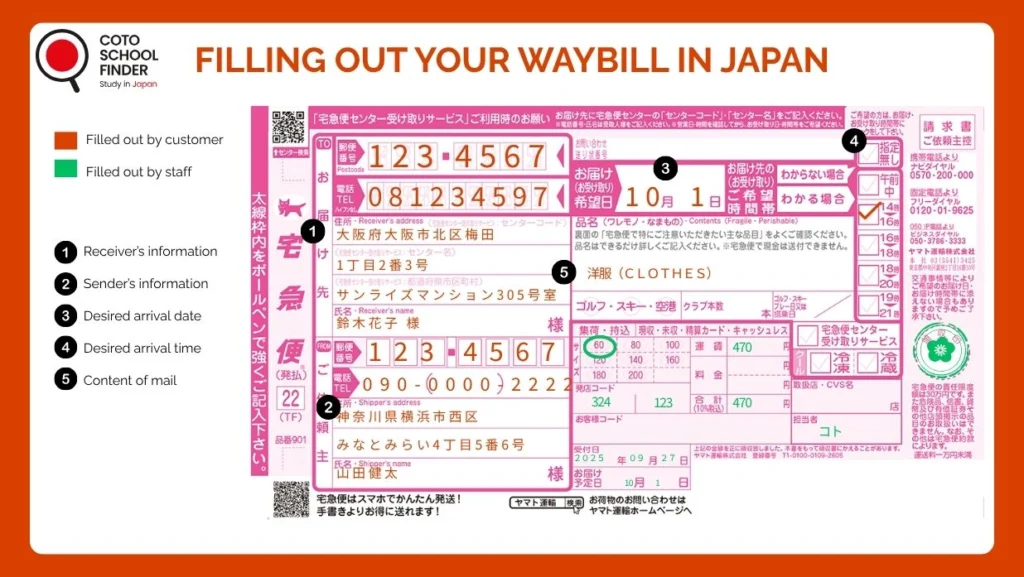
The delivery slip (伝票, Denpyo) is where you write the recipient’s address and name (お届け先, Otodokesaki), plus your own details as the sender (ご依頼主, Goiraishu). You will also write a short description of the contents (品名, Hinmei), such as “clothes” or “books”.
The slip also asks how you want to pay, and there are two options:
| Payment type | Meaning | When to use it |
|---|---|---|
| Prepaid (元払い, Motobarai) | You, the sender, pay at the counter | Most common, for gifts and everyday shipping |
| Collect on delivery (着払い, Chakubarai) | The recipient pays when the parcel arrives | When the recipient agreed to cover the cost |
If your handwriting is hard to read, ask the staff to help. At Yamato, you can also fill in the details in advance with their app and show a QR code at the store, which saves time at the counter.
Step 3: Staff Weigh the Parcel and Set the Price
At a post office or a konbini, staff will weigh your parcel and measure its size (サイズ, Saizu). Size is the total of the three sides (length + width + height), not the volume. For example, a box measuring 20 cm, 20 cm, and 20 cm is a 60 size (60サイズ, Rokujuu Saizu). The price depends on this size, the weight, and the distance, so sending a box farther away costs more.
Step 4: Choose Your Delivery Date and Pay
Choose the delivery date (お届け日, Otodokebi) and, if you want, a time slot (時間帯指定, Jikantai Shitei). Then pay at the counter. If you picked prepaid, you pay now. If you picked collect on delivery, you pay nothing. Keep the receipt, since it has your tracking number (お問い合わせ番号, Otoiawase Bango, “inquiry number”), which you can use to check the parcel’s status online.
Useful Vocabulary
| English | Japanese | Romaji |
|---|---|---|
| Parcel | 荷物 | Nimotsu |
| Delivery slip | 伝票 | Denpyo |
| Recipient’s address | お届け先 | Otodokesaki |
| Sender | ご依頼主 | Goiraishu |
| Contents | 品名 | Hinmei |
| Prepaid | 元払い | Motobarai |
| Collect on delivery | 着払い | Chakubarai |
| Delivery date | お届け日 | Otodokebi |
| Time slot | 時間帯指定 | Jikantai Shitei |
| Fragile | ワレモノ | Waremono |
| Refrigerated delivery | クール便 | Kuuru Bin |
| Tracking number | お問い合わせ番号 | Otoiawase Bango |
How to Send International Mail from Japan
We recommend Kuroneko for sending mail within Japan, but for international mail we recommend Japan Post. It is easy to use, reliable, and budget-friendly. Just choose the right service for your timeline and budget. The price depends on three things: what you send, how heavy it is, and where it is going.
Your Shipping Options
| Service | Speed | Cost | Best for |
|---|---|---|---|
| EMS (国際スピード郵便, Kokusai Supiido Yubin, “international speed mail”) | About 2 to 4 days | Highest | Urgent or valuable items |
| Airmail (航空便, Koukuubin, “air mail”) | About 1 week | Medium | Documents, gifts, postcards |
| SAL (エコノミー航空, Ekonomii Koukuu, “economy air”) | About 6 to 13 days | Lower than airmail | Non-urgent items, if your country is covered |
| Surface Mail (船便, Funabin, “ship mail”) | Weeks to months | Lowest | Heavy items that are not urgent |
EMS is the fastest and the most secure, with top-priority handling and tracking. Airmail is fast and reliable, which makes it a good fit for important documents and gifts. SAL sits in the middle on both cost and speed, but only some countries accept it. Surface mail is the cheapest by far, but it can take weeks or even months to arrive.
How Much Does It Cost?
International prices depend on the destination zone, so the same item costs more to send to Europe or the US than to Asia. These are common starting prices.
| Item | Weight | Approximate price |
|---|---|---|
| Postcard (airmail) | Standard size | ¥100 to anywhere in the world |
| Standard letter (airmail) | Up to 25g | From ¥120 |
| Standard letter (airmail) | Up to 50g | From ¥190 |
| Non-standard letter (airmail) | Up to 50g | From ¥230 |
| EMS to Asia | Up to 500g | From ¥1,450 |
| EMS to Europe or Oceania | Up to 500g | About ¥3,150 |
| EMS to the US | Up to 500g | About ¥3,900 |
Registered mail, insurance, and other extras cost more on top of these prices. Check the exact amount for your country on the Japan Post international rate page, or ask the staff at the counter.
Step 1: Choose Your Service
Decide how fast you need it to arrive and how much you want to spend. Then check that your destination country accepts that service. SAL and surface mail are not available everywhere, and some countries limit what they accept. Japan Post lists the current availability by country on its international mail page.
Step 2: Pack Your Item
For letters, use a standard envelope. For parcels, use a sturdy box with padding, and seal it well. International parcels go through more hands and more weather, so pack them more carefully than you would for domestic mail. Many post offices sell boxes and envelopes.
Step 3: Fill Out the Customs Form
Parcels and some mail need a customs declaration (税関告知書, Zeikan Kokuchisho). You write what is inside, how many items, their value, and the country they were made in. Be honest and specific. “Clothes” is fine, but “gift” alone is not. Many countries now also ask for the details to be sent electronically, and some recommend an HS code (a number that classifies the item). Staff at the counter can help you with this.
Step 4: Write the Address in English
Write the recipient’s address in English, with the country at the bottom in capital letters. Put your own address as the sender in the top left corner. Use the same order we showed in the address section above, adapted to the format of the destination country.
Step 5: Take It to the Post Office
Postcards and standard letters with the right stamp can go in a red postbox. Parcels, EMS, and anything that needs tracking, insurance, or a customs form must be handed over at a post office counter. Staff will weigh the item, check the contents, and confirm the price.
Step 6: Pay and Keep Your Receipt
Pay at the counter and keep the receipt. It shows your tracking number (お問い合わせ番号, Otoiawase Bango, “inquiry number”), which you can enter on the Japan Post website to follow your parcel.
Useful Vocabulary for Mailing in Japan
When visiting a post office or sending mail in Japan, knowing some basic terms can make the process smoother. Here’s a handy list of common words with their Hiragana, Romaji, and English translations:
| Japanese (Hiragana) | Romaji | English Translation |
|---|---|---|
| 郵便局 | Yuubinkyoku | Post Office |
| 切手 | Kitte | Stamp |
| 手紙 | Tegami | Letter |
| はがき | Hagaki | Postcard |
| 荷物 | Nimotsu | Package/Parcel |
| 住所 | Juusho | Address |
| 郵便番号 | Yuubin Bangou | Postal Code |
| 速達 | Sokutatsu | Express Delivery |
| 書留 | Kakitome | Registered Mail |
| 航空便 | Koukuubin | Airmail |
| 表 (おもて) | Omote | Front/Outside (of envelope) |
| 裏 (うら) | Ura | Back/Reverse |
| 国際郵便 | Kokusai Yuubin | International Mail |
| 小包 | Kozutsumi | Small Parcel |
| 配達 | Haitatsu | Delivery |
| 宛名 | Atena | Recipient’s Name |
| 発送 | Hassou | Shipment |
| 追跡番号 | Tsuiseki Bangou | Tracking Number |
Find more useful vocabulary on cheat sheet 1 and cheat sheet 2 of our blog!
Common Mistakes to Avoid
Even experienced expats can make mistakes when sending mail in Japan. Here’s what to watch out for:
- Incorrect Address Format:
Japanese addresses are written in a specific order. Always start with the postal code, followed by the prefecture, city, ward, street, building name, apartment number, and finally, the recipient’s name. Skipping any of these details can lead to delays. - Underpaying Postage:
Weigh your package carefully and ensure the postage matches its weight and size. Adding an extra stamp or two is better than having your mail returned (or not). - Skipping Customs Forms:
For international shipments, forgetting to fill out the required customs declaration can lead to delays, or worse, your package being sent back. Double-check all forms before sending.
Whether you’re paying bills back home or helping a family member, this service is a reliable way to handle your financial needs.
Japan’s postal system is one of the most reliable and efficient in the world. Whether you’re sending a simple letter, shipping a package internationally, or transferring money to another country, Japan Post has a service for you.
By following this guide, you’ll avoid common pitfalls and feel confident navigating the system, no matter your level of Japanese.
While you’re getting used to daily tasks like sending mail, you might also want to learn how to handle other practical processes in Japan, like converting your foreign driver’s license to a Japanese license.
Ready to study in Japan? Contact us for free support!
Sending mail in Japan is easy once you know the basics. Use a postbox for letters, Kuroneko at a konbini for domestic parcels, and Japan Post for international mail. Planning to study in Japan? Coto School Finder can help with the paperwork too.
FAQ
Can I track packages sent internationally from Japan?
Yes! Most international mail comes with a tracking number. Use the Japan Post website or app for updates.
What’s the cheapest way to send packages abroad?
Surface Mail is the most economical option, though it takes the longest to arrive.
Can I send money overseas using Japan Post?
Absolutely! Their International Money Transfer program is reliable and widely used.
How long does domestic mail take in Japan?
Within the same prefecture at minimum, 2 days later. A prefecture apart at minimum, 3 days later
How do I fill an envelope for mail in Japan?
Put the sender’s name and return address on the top left corner and the recipient’s name and mailing address in the lower center of your envelope.
What is the fastest mail service in Japan?
EMS is the fastest international mail service, allowing you to send up to 30 kg of documents and merchandise easily and efficiently to over 120 countries and regions around the world!
Read more how-to guides on: