




For international students who come to Japan, their goal is often to ultimately find a job in Japan (though in many cases, they also prefer to go back home). Most of you will typically be enrolled under a student visa, which, while it allows you to do part-time work under the right permit, does not allow you to work as a full-time (or even contract) employee. And after doing a thorough job hunt and finally getting a naitei (内定), or job offer (congratulations!), the next question that comes up is: how do I switch from a student visa to a work visa in Japan?
Though Coto School Finder has primarily helped students coming to study the Japanese language, this question comes up a lot, since many of the students we’ve supported have ended up diving straight into a job. In this guide, we’ll talk about the documents you need to adjust of status of residence, and what to expect.
Understanding Switching Visas in Japan: Student to Work Visa
If you’re already in Japan under a certain type of visa (in this case, student), switching to another type of long-term but non-permanent visa, regardless of what it is, typically falls under an Application for Change of Status of Residence at your local Regional Immigration Services Bureau. Do not submit the application for visa renewal or extension.
This is great news for two reasons: first, because you’re already in Japan, the change of status can be done directly at your local immigration services bureau (if you live in Tokyo, this will most likely be the Shinagawa or Tachikawa Immigration Services Bureau).
Second, it also allows you to bypass applying for a Certificate of Eligibility, as you do not need to enter Japan under this new residence status anymore.
Important Caveats to Know Before You Begin Your Process
Just to confirm, the work visa we’re talking about here is the most common type of professional working visa: the “Engineer/Specialist in Humanities/International Services” visa.
Japan has, by definition, different types of visas that allow you to work for different purposes. For example, the Specified Skilled Worker visa allows you to work in designated industries. The Instructor Visa is a visa meant for ALTs (Assistant Language Teachers) or teachers working in primary and secondary schools. What you need for each visa type depends on you and your job.
In most cases, you need to get a job offer first before you can apply for a work visa (unless you’re applying for something like an artist visa or entrepreneurial visa, where the route is more independent). This is because immigration sorts companies into four different categories, and the bulk of the required documents will most likely be provided by them, like financial statements, company profile, and more.
Always make sure you’re applying for the correct type of work visa. If you’re accepted for a role but your company suddenly asks you to apply for a completely different visa (there was a case where a friend of mine was asked to apply for a Designated Activities visa when she’d landed a full-time job), flag it. There’s a chance they’re trying to work around legal obligations, or it could even be a black company (a company known for exploitative labor practices).
Read more: What are the requirements to work in Japan?
How Much Does Renewing or Changing My Visa Cost?
As of August 2026, changing your status of residence in Japan currently costs ¥6,000, but Japan has recently approved the motion to increase the fee for renewing or changing visa status drastically under a tier system, which will come into effect on October 1.
For stays of up to 3 months, the fee is rising to a flat ¥10,000 either way. For a one-year stay, the fee will rise to ¥33,000 at the counter and ¥27,000 online. For stays of five years or longer, the fee will rise to ¥75,000 at the counter and ¥65,000 online.
Can I Have Someone Do My Application for Change of Status of Residence?
In my experience switching from a student visa to a work visa, I saw a few of my friends who had their company handle everything. Don’t take this as an industry-wide practice, though.
In general, individuals need to apply for the change of status of residence themselves, but are allowed different options.
According to the official Japanese Immigration Services Agency website, for most working adults switching from student to work visa, your realistic options are do it yourself, have your company’s designated staff submit it for you, or hire a registered immigration lawyer/scrivener.
Those who had their work visa “handled” (meaning they didn’t need to be the one going to immigration) often had the company hiring an immigration lawyer or legal team to handle it on their behalf. These are often bigger, international companies that are used to handling paperwork and a large volume of employees needing to switch or apply for a work visa.
In reality, small and medium-sized enterprises account for 99.7% of all companies in Japan, and many of them don’t have the resources or experience to apply for a work visa on your behalf. In most cases, don’t be surprised to know that you handle everything yourself.
Documents You Need to Apply for Switching from Student Visa to Work Visa in Japan
Application to change your status of residence requires documents from two sides: you, and the company or organization sponsoring you. For the most part, the documents you’ll need to provide stay fairly consistent (though Japanese immigration policies are always changing), the biggest variable is the company.
Documents From You (the Individual)
1. Passport and Residence Card. Make sure your passport hasn’t expired.
2. Permission to Change Status of Residence Application. The application forms differ depending on the status of residence you’re applying for. You can get the application form from immigration or download it from the Ministry of Justice website: Application for Permission to Change Status of Residence.
(While the physical form is provided at the immigration center, we recommend not filling it out there. Print ahead, fill them out, and have everything ready before you head there!)
3. A 3cm x 4cm Photo ID
You can also use a copy of the form. An ID photo (3cm x 4cm) is required and should be attached to the application.
3. Proof of Japanese Language Ability
Starting from April 2026, if your job primarily involves using language skills (like interpreting, translating, or customer-facing roles such as hotel front desk work), proof that your language ability is equivalent to CEFR B2 level.
However, you’re automatically considered CEFR B2-equivalent if you meet any of these:
- Hold JLPT N2 or higher
- Scored 400+ on the BJT Business Japanese Proficiency Test
- Have lived in Japan as a medium- to long-term resident for 20+ years
- Graduated from a Japanese university, or completed a specialized/advanced course at a Japanese technical college or vocational school
- Completed compulsory education in Japan and graduated from a Japanese high school
This applies specifically when your job is classified as “translation/interpretation” or “customer service” type work in your Certificate of Eligibility, Change of Status, or Acquisition of Status application.
(The official Ministry of Justice website states that if you have done the same type of work as before when applying for an extension of your period of stay, you are not required to submit this document. However, you may be asked to submit it if necessary during the review process.)
Reason for Application: While it’s not strictly mandatory to submit this, writing an explanation of why you’re pursuing this job, and how it relates to the field you majored in, becomes a useful reference during screening. There’s no set format for this, but we recommend formatting it letter-style.
Documents From the Company
This is where it gets a bit tricky. Before immigration looks at your profile and job position, they look at your company, which is technically going to be your sponsor.
Every organization that sponsors a work visa gets sorted into one of four categories by Japan’s Immigration Services Agency, based on size, status, and tax record. This category applies mainly to the Engineer/Specialist in Humanities/International Services visa and determines how many documents they need to submit.
| Category | Who Qualifies |
|---|---|
| 1 | Listed companies, government bodies, public-interest corporations |
| 2 | Employers with 10 million yen+ in withheld salary tax last year |
| 3 | Employers that filed the withholding tax report, below 10 million yen |
| 4 | Everyone else, typically new or very small companies |
Most job seekers never hear about this system until they’re deep in their visa application. Unfortunately, many Category 3 or 4 companies don’t know about it either, since they’re typically small businesses without much experience sponsoring visas. By then, applicants are staring down a request for documents their employer doesn’t have ready.
We recommend discussing all the required documents with your employer, and even though the responsibility of submitting them falls on the company, always double-check against the official Japanese immigration website to make sure you’ve been given the complete list.
| Document | Category 1 | Category 2 | Category 3 | Category 4 |
|---|---|---|---|---|
| Application form, photo, return envelope | Yes | Yes | Yes | Yes |
| Category-proof document | Listing or government proof | Withholding tax report | Withholding tax report | N/A |
| Your job duties (labor contract terms) | No | No | Yes | Yes |
| Your education and work history proof | No | No | Yes | Yes |
| Company registry certificate | No | No | Yes | Yes |
| Business description and major clients | No | No | Yes | Yes |
| Financial statements, or a business plan | No | No | Yes | Yes |
| Declaration form regarding the representative of the affiliated organization | No | No | Yes | Yes |
Process of Changing Your Status of Residence in Japan
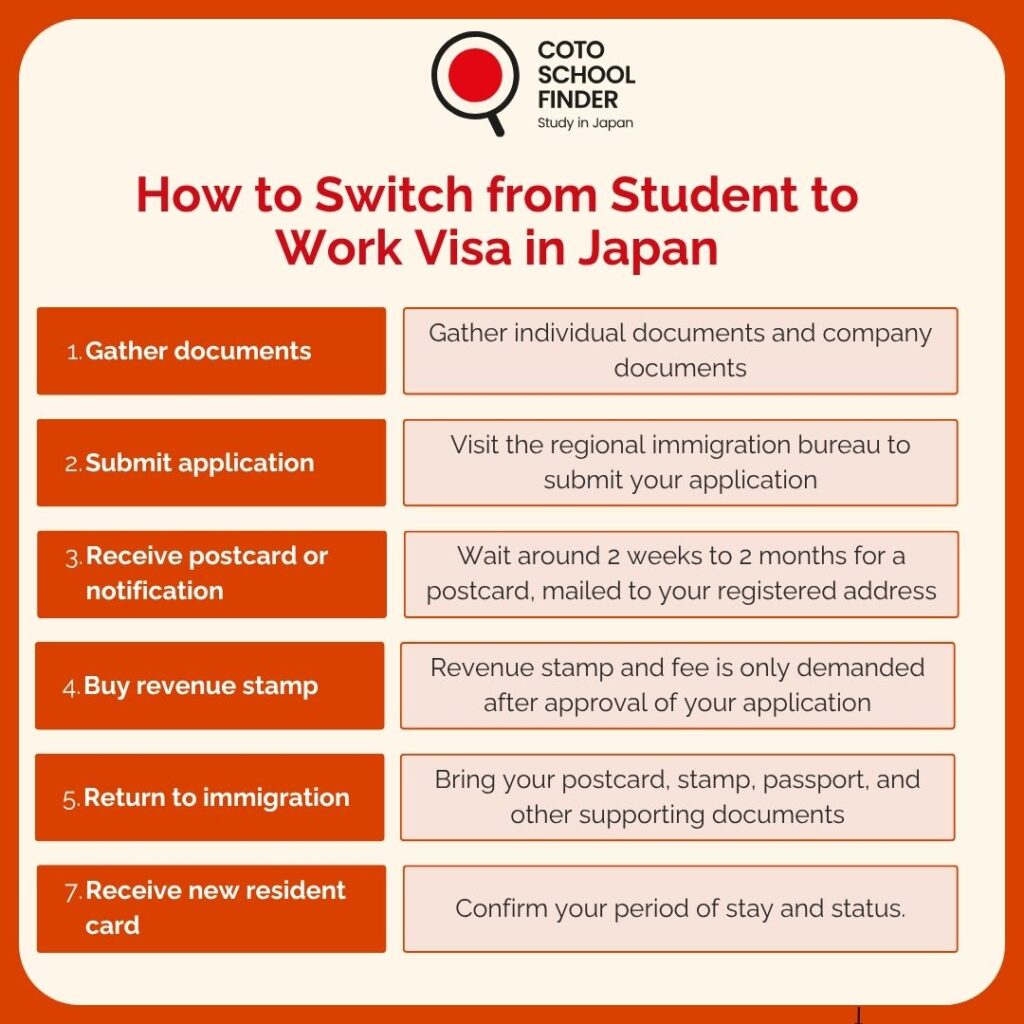
1. Gather all the documents
Like we mentioned, unless your company explicitly says they’ll handle all the paperwork, always assume you’ll be doing this yourself. In my experience, companies will provide the documents required from their side. Your job is to compile the documents from your side too, including the application itself.
2. Go to the closest immigration office and apply
By now, I’ve had my fair share of trips to immigration — for extending my visa, changing my visa, and even losing my residence card in Japan — so I know the flow.
The first thing you do at any immigration bureau in Japan is line up for a number. This number is your waiting number, but it also serves as a preliminary check by immigration staff to see if all your documents are complete. At this point, make sure you’ve also completed the Application for Change of Status of Residence so they know what else you need.
From there, you’ll wait until your number is called. There are usually different windows for different staff, so head to the window matching your number and submit your documents to the immigration staff. They might want to verify a few things.
Important: Starting in 2026, Japanese immigration requires those applying for the Engineer/Specialist in Humanities/International Services visa whose job will use Japanese to hold JLPT N2 level. While this might not apply to you since you’re already in Japan, if you have a JLPT N2 certificate or something equivalent, we recommend bringing it anyway.
3. Head home and wait for the postcard from immigration
During this waiting period, you’ll also get a temporary stamp (or small paper slip/sticker) on the back of your Residence Card as proof that your application is in process. This stamp extends your legal stay in Japan for up to 2 months, or until a final decision is made, even if your original visa expiry date passes in the meantime.
In my experience, as long as your job position is clear and you have all the right documents, the process should be pretty seamless.
That said, even if the experience at the counter felt positive on the day you applied, it doesn’t guarantee approval, and vice versa. Immigration staff can’t approve your visa on the spot.
So the waiting game begins once you head home: you’ll be waiting for a postcard to arrive at your registered address.
If you receive the postcard, there’s a good chance your visa application has been approved!
Occasionally, instead you might receive what’s called a Notice of Submission of Additional Materials (追加資料提出通知, Tsuika Shiryo Teishutsu Tsuchi) from the Japan Immigration Services Agency. This means your application is paused, and they want you to submit additional information. It does not mean rejection.
4. Buy the revenue stamp
Before heading back to immigration, buy a revenue stamp. This is how you pay the government fee for the change of status. You can usually get one at a convenience store or at a post office.
5. Head to immigration to receive your new visa
Bring the postcard, revenue stamp, passport, and residence card to the designated window. If approved, staff will affix the revenue stamp to your file and issue your new residence card on the spot, with your new status of residence and updated period of stay.
Does the Immigration Staff Speak English?
In my experience, and from watching other applicants at immigration, most foreigners there speak Japanese with the staff. I assume this is because those applying for a residence card in Japan already have some experience living here, so they tend to have a bit more Japanese ability, whereas someone applying for an entirely new visa from overseas wouldn’t.
That said, don’t be afraid if you don’t speak Japanese. The first year I needed to extend my student visa, my Japanese was also pretty rough. There were a few times staff asked something I didn’t understand, but thankfully:
- Applications often come with both English and Japanese translations.
- If you don’t speak English, they sometimes provide basic translation papers and applications in other common languages, like Chinese, Korean, and Vietnamese.
- Immigration staff are pretty used to communicating with foreigners, so in cases where I didn’t understand, they’d use hand gestures, simplify their Japanese, and sometimes speak a bit of basic English.
That said, try to familiarize yourself with the basic terms that might come up during your immigration visit, such as:
| Japanese | Romaji | English |
|---|---|---|
| 在留資格 | zairyuu shikaku | Status of residence |
| 在留カード | zairyuu kaado | Residence card |
| 在留資格変更許可申請 | zairyuu shikaku henkou kyoka shinsei | Application for Change of Status of Residence |
| 在留期間更新許可申請 | zairyuu kikan koushin kyoka shinsei | Application for Extension of Period of Stay |
| 在留資格認定証明書 | zairyuu shikaku nintei shoumeisho | Certificate of Eligibility |
| 出入国在留管理庁 | shutsunyuukoku zairyuu kanri chou | Immigration Services Agency (ISA) |
| 地方出入国在留管理局 | chihou shutsunyuukoku zairyuu kanri kyoku | Regional Immigration Services Bureau |
| 技術・人文知識・国際業務 | gijutsu, jinbun chishiki, kokusai gyoumu | Engineer/Specialist in Humanities/International Services visa |
| 留学 | ryuugaku | Student (status of residence) |
| 資格外活動許可 | shikakugai katsudou kyoka | Permission to Engage in Activity Other Than That Permitted (part-time work permit) |
| 収入印紙 | shuunyuu inshi | Revenue stamp |
| 追加資料提出通知 | tsuika shiryou teishutsu tsuuchi | Notice of Submission of Additional Materials |
| 不許可通知書 | fukyoka tsuuchisho | Notice of Non-Permission (denial notice) |
| 許可通知書 | kyoka tsuuchisho | Notice of Permission (approval notice) |
| はがき | hagaki | Postcard (notifying application status) |
| 所属機関 | shozoku kikan | Affiliated organization / sponsoring company |
| 特定活動 | tokutei katsudou | Designated Activities visa |
| 在留期間 | zairyuu kikan | Period of stay |
I Got a Notice of Submission of Additional Materials (Tsuika Shiryo Teishutsu Tsuchi / 追加資料提出通知). What Should I Do?
Occasionally, you might receive a notice of submission of additional materials instead of a postcard. Do not treat this as a rejection. This notice means immigration reviewed your file and found something incomplete or unclear.
The letter will specify which document(s) are missing or need clarification.
A lot of the requested materials might come from your employer, not you. This might include financial statements, company registry, or a clearer explanation of your job duties.
Flag it to your company. You’ll typically bring the additional materials back to the same immigration bureau that’s handling your case. Some offices allow submission by mail; check the notice itself for accepted methods, since this can vary by bureau.
How Soon Can I Get My New Residence Card?
Most visa extensions or status changes take between 2 weeks and 2 months to process at the Immigration Services Agency, but processing time is very dependent on the season you apply and your location.
For example, if you’re applying in Tokyo, which has a higher concentration of companies and foreign workers, wait times might be longer.
Also, keep in mind peak job-hunting season. The busiest times at immigration offices in Japan are from March to April, which covers the transition period for new school graduates, new hires, and job changers.
In general, the government in Japan often notes there’s a larger volume of applicants during Golden Week and the periods just before and after long holidays.
Remember: a longer processing time doesn’t always mean a bad thing.
I’m Actively Waiting for My Change of Status Approval. Can I Work for My Company While Waiting?
No, you can’t start working as a full-time employee while your Change of Status application is pending. Until immigration approves your change and issues your new residence card, you legally remain under your current status of residence (in this case, student) with all its existing restrictions. You’re still capped at whatever your part-time work permit allows, which is usually 28 hours/day.
Who Pays for the Change of Status Fee? My Company or Myself?
This is very much a case-by-case thing. In my own experience, I’ve always paid for my visa fee myself. I handled gathering the documents and going to the immigration myself. In hindsight, I was also paying the old flat rate of ¥6,000. I got a 5-year visa on my third extension, which worked out well timing-wise.
Meanwhile, friends of mine who worked at bigger companies that handled their visa applications didn’t have to pay for anything themselves.
But with the new tiered pricing system, where a 5-year visa can cost up to ¥75,000 starting October 2026, this is now a real investment. I think it’s more important than ever, and not at all out of the line, to simply ask your company upfront: who’s going to handle this fee?
What Do I Need to Do After My Change of Residence of Status is Complete?
1. Switch your health insurance
As a student, you were likely on National Health Insurance (国民健康保険, Kokumin Kenko Hoken) through your city/ward office. Once you start working full-time, your employer should enroll you in Employees’ Health Insurance (健康保険, Kenko Hoken) instead.
Bring your new residence card and any documentation your employer gives you showing you’re now enrolled in shakai hoken, so you’re not double-paying or lapsing coverage.
2. Switch your pension enrollment
Similarly, students are usually on National Pension (国民年金, Kokumin Nenkin). As a full-time employee, you’ll move to Employees’ Pension Insurance (厚生年金, Kosei Nenkin), which your employer handles and deducts from your salary.
3. Update your residence tax situation
Your residence tax (住民税, juminzei) obligations may shift depending on your new income level. This usually gets sorted through your employer’s payroll once you’re on their books, but it’s worth confirming, especially for your first year.
4. Check your bank and any registered accounts
Some banks flag or restrict accounts when your visa is expiring. With the new change of status, this often mean you have more years – 1,3 or 5 years, so notify or submit this worth informing your bank of your new status of residence, especially if you plan to do things like apply for a credit card or a loan later.
5. Update your employer with your new residence card details
Your employer will likely need a copy of your new residence card for their records (proof you’re authorized to work in your new role).
Final Thoughts
For me, switching from a student visa to a work visa in Japan wasn’t just a big administrative (and legal) step, but a life one, too. It marked the moment I got to live out one of my many dreams: actually working in Japan and building a career here.
And if you’re still in the earlier stages of your journey, whether you’re choosing a Japanese language school, figuring out your student visa, or just starting to think about what comes after graduation, I recommend Coto School Finder. We can help you find the right school to set you up for success from day one.
FAQ
Can I work full-time while my Change of Status application is pending in Japan?
No. Until immigration approves your change and issues your new residence card, you legally remain under your student status, capped at whatever your part-time work permit allows.
What happens if I receive a Notice of Submission of Additional Materials instead of a postcard?
It’s not a rejection. It means immigration needs more documents or clarification before deciding. You’ll typically resubmit the requested materials to the same immigration bureau handling your case.
How long does it take to get my new residence card?
Usually between 2 weeks and 2 months, though this depends heavily on the season and where you’re applying — Tokyo tends to run slower, especially during peak periods like March–April and Golden Week.
Do I need to prove my Japanese language ability to get a work visa?
Only if your job is classified as translation/interpretation or customer-facing work using language skills (like hotel front desk), and only starting from April 2026. You’re automatically exempt if you hold JLPT N2 or higher, among other qualifying criteria.
Read more visa-related content:
How to Switch from Working Holiday to Work Visa in Japan
Tokutei Zairyuu Card: What to Know About Japan’s New Residence Card